Advanced computational software is streamlining quantum chemistry research by automating many of the processes of running molecular simulations. The complicated design of these software packages, however, often limits their use to theoretical chemists trained in specialized computing techniques.
Monday, April 7, 2025
Chatbot opens computational chemistry to nonexperts
Advanced computational software is streamlining quantum chemistry research by automating many of the processes of running molecular simulations. The complicated design of these software packages, however, often limits their use to theoretical chemists trained in specialized computing techniques.
Wednesday, March 19, 2025
'Doctors by Nature': In a new book, a biologist explores how animals heal themselves
In 2010, Emory University biologist Jaap de Roode published the discovery that monarch butterflies use medicine to cure their offspring of disease. His lab revealed how, if infected with a parasite, the female butterflies prefer to lay their eggs on a species of milkweed containing higher levels of a toxic chemical. The caterpillars eat the milkweed, ingest the toxin, and reduce the parasite load in their bodies.
With that finding, de Roode joined the vanguard of scientists uncovering how animals treat themselves for diseases.
“We showed how even an insect with a teeny-tiny brain can medicate,” de Roode says. “From there it was a natural progression to the understanding that, in principle, any animal can do it.”
In his new book, “Doctors by Nature: How Ants, Apes and Other Animals Heal Themselves,” de Roode explores the growing field of animal self-medication. He interviews scientists around the globe and describes research into how animals from ants to apes, birds to bears — even family dogs and cats — use various forms of medicine.
Wednesday, March 5, 2025
Atlanta Science Festival set to entertain, inspire and engage all ages
By Carol Clark
Atlanta Science Festival returns March 8-22, with more than 100 events throughout the metro area, inviting the public to join fun, interactive and educational experiences. The acclaimed city-wide celebration, one of the largest of its kind in the country, showcases the myriad science, technology engineering and mathematics (STEM) innovations happening in Atlanta, including at Emory.Wednesday, November 13, 2024
Chemists showcase power of pathbreaking method to make complex molecules
Chemists synthesized a highly complex natural molecule through a revolutionary strategy of functionalizing normally inert carbon-hydrogen (C-H). Science published the breakthrough led by chemists at Emory University and Caltech.
Wednesday, July 24, 2024
White House taps Emory expert to speak on climate resilience panel
Tuesday, April 9, 2024
Tracking ticks in Georgia to help monitor emerging diseases
By Carol Clark
![]() |
| The Asian longhorned tick (CDC) |
Monday, October 23, 2023
Emory breaking new ground for climate-smart agriculture in the Southeast
Three Emory University researchers received $5,100,000 as part of a United States Department of Agriculture (USDA) project to help measure and promote climate-smart practices that support small-scale, diversified vegetable farmers in the Southern Piedmont. A plateau below the Appalachian Mountains and above the coastal plain, the Southern Piedmont is a banana-shaped region spanning a bit of eastern Alabama, up across part of northern Georgia and into North and South Carolina and Virginia.
Emory is one of 12 organizations involved in the $25 million project, headed by the Rodale Institute and titled “Quantifying the Potential to Reduce Greenhouse Gas Emissions and Increase Carbon Sequestration by Growing and Marketing Climate-Smart Commodities in the Southern Piedmont.”
The five-year project is part of the USDA’s Partnerships for Climate-Smart Commodities initiative. “This effort will increase the competitive advantage of U.S. agriculture both domestically and internationally, build wealth that stays in rural communities and support a diverse range of producers and operation types,” USDA Secretary Tom Vilsack says of the initiative.
The Emory team encompasses three faculty from the Department of Environmental Sciences: Emily Burchfield, Eri Saikawa and Debjani Sihi.
• Burchfield combines spatial-temporal social and environmental data to understand the future of food security in the United States.
• Saikawa is an atmospheric chemist who models global soil nitrous oxide emissions and quantifies soil greenhouse gas fluxes.
• Sihi is an environmental biogeochemist who researches soil organic matter dynamics and greenhouse gas emissions from natural and managed systems.
Related:
Climate change on course to hit U.S. corn belt especially hard
Diverse land cover boosts yields for major U.S. crops, study finds
Soil quality critical to help some U.S. crops weather climate change
Friday, November 18, 2022
Emory students promote youth power at U.N. conference
By Carol Clark
Emory students helped raise the profiles of youth activists during this year’s United Nations Framework Convention on Climate Change, better known as COP, continuing through Nov. 18 in Sharm El-Sheikh, Egypt.
A delegation of five Emory undergraduates and four graduate students, led by Eri Saikawa, associate professor of environmental sciences, attended the first week of COP as official U.N. observers. They sat in on negotiations and co-hosted a side event with the Climate Justice Program entitled “Youth: From Resistance to Power.” The event featured a panel discussion by four young activists — from Pakistan, Kenya, Mexico and the Philippines — followed by an interactive networking event moderated by the Emory students.
“It’s inspiring and energizing seeing so many youth raising their voices and pushing for climate action,” says Saikawa.
Saikawa began leading students from her Climate Change and Society class to the annual global climate talks in 2015, when COP was held in Paris. That year, nearly 200 member countries hammered out the Paris Agreement, aiming to keep the global mean rise in temperature to no more than 2 degrees Celsius above preindustrial levels.
Student delegates will share what they learned during this year’s COP at a campus event entitled “Climate Conversations: Advancing Towards Global Justice” on Thursday, Nov. 17 at 6 pm in the Emory Student Center, multi-purpose rooms 5 and 6. Attendees can join in activities geared to the topics of environmental justice, climate and business, urban planning, conservation and more.
The students will also produce podcasts on different aspects of COP for the Emory Climate Talks AmpliFIRE series.
Following are brief summaries of the experiences and views of four of the Emory undergraduates who traveled to Egypt for COP.
"Right after we touched down in Sharm El-Sheikh we grabbed our badges and headed to the conference," says Gabriela Rucker, right, shown with fellow senior Clare McCarthy.“It was exciting to be immersed among 45,000 people working to generate solutions to the climate crisis," says Gabriela Rucker, a senior majoring in environmental sciences on the social science and policy track.
Her interest in sustainable agriculture took her to the food-systems pavilion. She learned about programs to compensate farmers for preserving ecosystems and the increasing use of seaweed as a nutrient. “That was cool, right off the bat, to hear about those food solutions.”
Rucker is a member of the Plastic-Free Emory task force and appreciated insights from Eric Njuguna, an activist from Kenya, during the “Youth: From Resistance to Power” event.
“The United States exports a significant amount of plastics and other recycling abroad, where it ends up in landfills and becomes another country’s problem,” she says. “Eric Njuguna talked about his experiences dealing with trash from the United States. It’s important that people in the United States understand where our trash goes when we throw it away.”
The connections she made during COP were a highlight for Rucker. “I met a lot of youth with passion and drive,” she says. “We have our careers in front of us so connecting with fellow youth about where they want to go and what they want to work on was invaluable.”
Rucker is currently an intern at a solar-power development company. “My dream job would involve building solar plants to provide clean electricity for the United States,” she says. “During the next 20 years we need to build out a significant amount of renewable energy infrastructure.”
Ultimately, COP further fueled her optimism. “I generally have a lot of hope for the progress of humanity,” Rucker says. “I’ve witnessed throughout my life people’s work toward a cleaner and more equitable society. My hope stems from the people who are doing the work to make that vision happen.”
Senior Jack Miklaucic is grateful for the anonymous donor who funds the trips by Emory students to COP. "It's a tribute to Dr. Saikawa's work that a donor is willing to do this for her students year after year," he says.“The best part of COP for me was attending events led by civic groups doing energy-justice advocacy, which is the kind of work that I want to do,” says Jack Miklaucic, a senior majoring in environmental sciences and philosophy, politics and law. “They were led by really cool people who are fearless about calling out the fossil fuel companies and speaking truth to power. Hopefully, their examples will make me a more effective activist going forward.”
Miklaucic plans to attend law school and hopes for a career involved with ensuring that utility companies and other energy providers are better regulated. “I want my work to have a direct, positive impact on society,” he says.
“Enhancing energy efficiency is a big win for everybody,” Miklaucic adds. “It will improve people’s lives on the economic, climate and health levels. We’re already seeing movement toward more energy efficiency so that provides incentive to keep working towards more.”
He is optimistic regarding climate solutions. “We were looking at a 3-to-4-degree Celsius rise in the global temperature average a few years ago and that’s no longer likely,” he points out. ”It’s important to stay focused on what kind of impact we can make because every tenth of a degree matters for what kind of world we’re going to live in.”
Miklaucic appreciated the international perspective he gained from COP. “It was interesting to learn how climate activism is different around the world,” he says. “In some places they are persecuted and outright killed for doing what they do. It drove home to me that while it can be frustrating at times working for energy justice in the United States, it’s also a much safer place to be doing it.”
"Every single person will be affected," says senior Clare McCarthy of climate change.Clare McCarthy is a senior majoring in environmental sciences on the community building and social change track. She is also pursuing the 4+1 BS/MPH in environmental health at Rollins School of Public Health.
She began learning about how the climate crisis is a social justice issue while she was in high school. It made her feel guilty to realize how people in the Global South tend to disproportionately suffer the greatest impacts of climate change as opposed to more privileged people in her hometown, where climate change felt distant.
“That guilt paralyzed me,” she recalls, “until I came to Emory, when I decided to take action.” McCarthy is involved in efforts to hold the Emory administration accountable to stronger climate action through the Emory Climate Coalition and Emory Climate Reality Project.
COP helped solidify her interest in loss and damage, or the harmful impacts of climate change, as well as efforts by local communities to adapt. She learned more about these issues first-hand by talking to leaders of nongovernment organizations, such as the International Center for Climate Change and Development, based in Bangladesh.
“Loss and damage and how to address it became a headline issue for the first time at this year’s COP,” McCarthy says. “While it’s great to see this, it cannot be celebrated as a final victory because it’s way overdue and much more work is needed.”
Countries in the Global South are asking countries in the Global North to set up a mechanism for financing recovery from both economic and health impacts due to climate events. “They want the money to be payments and not in the form of loans because then they will be in debt,” McCarthy says.
She envisions a career working internationally or within the United States to help communities build their capacity to respond to climate change.
“It makes me feel hopeful to meet so many impressive people working on solutions,” McCarthy says. “The passion and dedication of my fellow activists, here at Emory and in communities around the world, keeps me going.”
"Climate change is the greatest challenge that my generation faces," says senior Jackson Pentz, second from right. While in Egypt he visited the Great Sphinx of Giza along with his fellow undergraduates, (from left) Clare McCarthy, Gabriela Rucker, Jack Miklaucic and Nick Chang.“A lot of people associate environmental science with governmental policy but I’ve always been interested in business as a way of creating social change,” says Jackson Pentz, a senior majoring in Economics and Environmental Science on the Social Science and Policy Track. Pentz is also a member of the Goizueta Business School’s Environmental Management program.
At COP he was impressed to learn that companies that compete for market share are actually collaborating on sustainability. “Many businesses are finding that in order to address sustainability issues they need to pool their research-and-development funding and share their knowledge,” he says. “The private sector is taking sustainability seriously and can come together more quickly and effectively than governments.”
Pentz already has a job lined up after he graduates in May. He’ll be working as a business consultant at McKinsey and Company specializing in sustainability and natural resources.
Thinking about the climate crisis at the global, or even the national, level can make you feel helpless, he says. “But if you zoom in on individuals or organizations at the smaller scale, you start to see lots of positive action that can be replicated to make a bigger impact,” he adds.
At the “Youth: Resistance to Power” event Pentz was buoyed by the remarks of Ayisha Saddiqa, a young climate justice activist who grew up in Pakistan as the member of an Indigenous community.
“She told us that young people shouldn’t feel responsible for saving the world. That’s obviously too big of a burden,” Pentz says. “But she personally feels responsible for working to help her community. If everybody does something manageable to help those around them, that’s how you start a social movement and collective action to improve things on a global scale.”
Related:
Youth views on climate take the world stage
Peachtree to Paris: Emory delegation headed to climate talks
Friday, September 9, 2022
Physicist seeks ultimate formula for fun
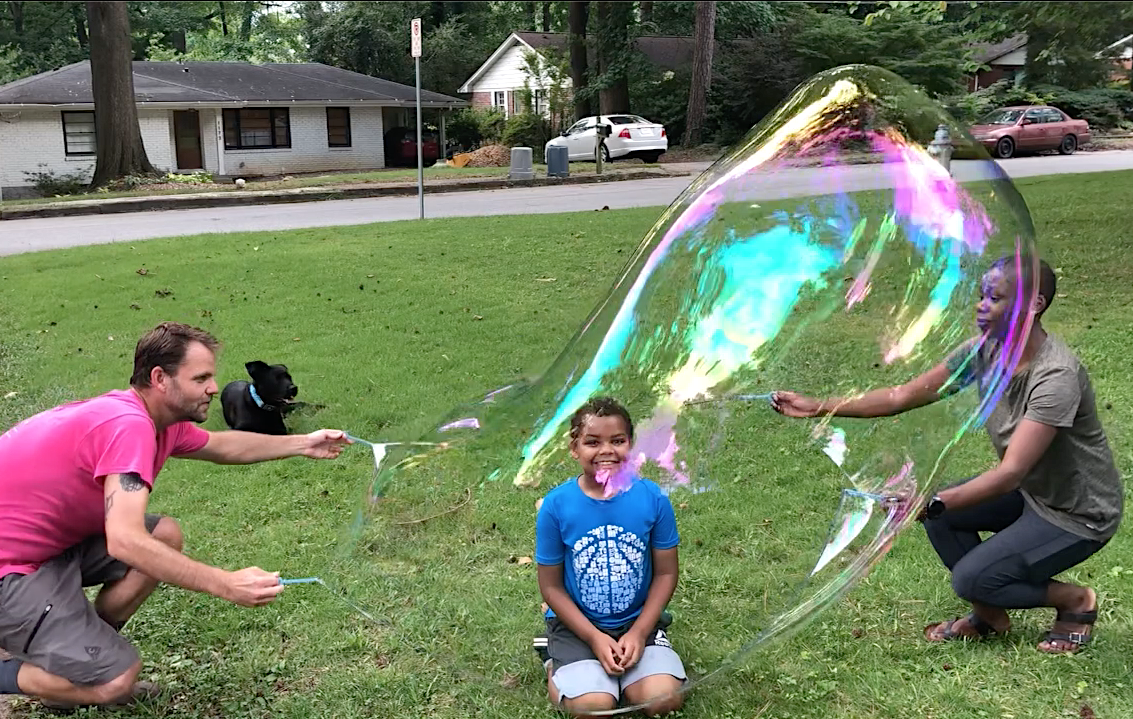
Justin and Afeira Burton encase their son Jonah in a giant bubble while their dog Boba Fetch looks on.
By day, Justin Burton is an Emory associate professor of physics, conducing high-level research on fluid dynamics and granular materials. Evenings and weekends, however, he turns into a comic-book version of a scientist. Not a mad scientist, tough. More like a glad scientist.
Read more about his alter ego, Dr. Bubbles, here.
Related:
Wednesday, March 16, 2022
Heartland virus identified in lone star ticks in Georgia
By Carol Clark
Atlanta Science Fest celebrates the wonders all around us
A celebration of science once again takes metro Atlanta by storm with the return of the Atlanta Science Festival, ongoing through March 26. More than 100 activities, planned throughout the city, invite families to experience the thrills of discovery, from nature walks to expert talks and hands-on STEM learning opportunities.
Tuesday, November 9, 2021
Biological studies often misinterpret sex-based data, analysis finds
By Carol Clark
An analysis of published studies from a range of biological specialties shows that, when data are reported by sex, critical statistical analyses are often missing and the findings are likely to be reported in misleading ways.
The journal eLife published the analysis, done by neuroscientists at Emory University, encompassing studies from nine different biological disciplines that involved either human or animal subjects.
“We found that when researchers report that males and females respond differently to a manipulation such as a drug treatment, 70 percent of the time the researchers have not actually compared those responses statistically at all,” says senior author Donna Maney, a professor of neuroscience in Emory’s Department of Psychology. “In other words, an alarming percentage of claims of sex differences are not backed by sufficient evidence.”
In the articles missing the proper evidence, she adds, sex-specific effects were claimed in nearly 90 percent of the cases. In contrast, authors that tested statistically for sex-specific effects reported them only 63 percent of the time.
‘’Our results suggest that researchers are predisposed to finding sex differences and that sex-specific effects are likely over-reported in the literature,” Maney says.
This particular problem is common and pertains to Maney’s own previous work, she adds. “Once I realized how prevalent it is, I went back and checked my own published articles and there it was,” she says. “I myself have claimed a sex difference without comparing males and females statistically.”
Maney stresses that the problem should not be discounted just because it is common. It is becoming increasingly serious, she says, because of mounting pressure from funding agencies and journals to study both sexes, and interest from the medical community to develop sex-specific treatments.
Maney is a behavioral neuroendocrinologist interested in how research on sex differences shapes public opinion and policy. Rigorous standards are needed, she says, to ensure that people of all genders have access to care that is appropriate for them.
Yesenia Garcia-Sifuentes, an Emory PhD candidate in the Graduate Program in Neuroscience, is co-author of the eLife analysis.
Better training and oversight are needed to ensure scientific rigor in research on sex differences, the authors write: “We call upon funding agencies, journal editors and our colleagues to raise the bar when it comes to testing for and reporting sex differences.”
More studies including sex-based variables
Historically, biomedical research has often included just one sex, usually biased toward males. In 1993, Congress wrote a policy into law to ensure that women are included in clinical studies funded by the National Institutes of Health whenever feasible, and that the studies be carried out so that it is possible to analyze whether the variables being studied affect women differently than other participants.
In 2016, the NIH announced a policy that also requires the consideration of sex as a biological variable when feasible in basic biological studies that it funds, whether that research involves animals or humans.
“If you’re trying to model anything relevant to a general population, you should include both sexes,” Maney explains. “There are a lot of ways that animals can vary, and sex is one of them. Leaving out half of the population makes a study less rigorous.”
As more studies consider sex-based differences, Maney adds, it is important ensure that the methods underlying their analyses are sound.
For the eLife analysis, Garcia-Sifuentes and Maney looked at 147 studies published in 2019 to investigate what is typically used as evidence of sex differences. The studies ranged across nine different biological disciplines and included everything from field studies on giraffes to immune responses in humans.
The studies that were analyzed all included both males and females and separated the data by sex. Garcia-Sifuentes and Maney found that the sexes were compared, either statistically or by assertion, in 80 percent of the articles. And, within those articles, sex differences were reported in 70 percent of them and treated as a major finding in about half of those.
Some of the studies that reported a sex difference, however, committed a statistical error. For example, if researchers found a statistically significant effect of a treatment on one sex but not the other, they typically concluded a sex difference even if the effect of the treatment was not compared statistically between males and females.
The problem with that approach is that the statistical tests conducted on each sex can’t give “yes” or “no” answers about whether the treatment had an effect.
“Comparing the outcome of two independent tests is like comparing a ‘maybe so’ with an ‘I don’t know’ or ‘too soon to tell,’” Maney explains. “You’re just guessing. To show actual evidence that the response to treatment differed between females and males, you need to show statistically that the effect of treatment depended on sex. That is, to claim a ‘sex-specific’ effect, you must demonstrate that the effect in one sex was statistically different from the effect in the other.”
On the flip side, the eLife analysis also encountered strategies that could mask sex differences, such as pooling data from males and females without testing for a difference. Maney recommends reporting the size of the difference — that is, the extent to which the sexes don’t overlap — before pooling data. She provides a free online tool that lets researchers visualize their data to assess the size of the difference.
“At this moment in history, the stakes are high,” Maney says. “Misreported findings may affect health care decisions in dangerous ways. Particularly in cases where sex-based differences may be used to determine what treatment someone gets for a particular condition, we need to proceed cautiously. We need to hold ourselves to a very high standard when it comes to scientific rigor.”
Related:
Wednesday, November 3, 2021
Youth views on climate crisis take world stage
Emory students and alumni are raising diverse voices on equity during the United Nations Conference of the Parties on Climate Change (COP26) now underway in Glasgow. This year, Emory is not sending an in-person student delegation, due to the pandemic and related concerns, says Eri Saikawa, associate professor of environmental sciences, who normally leads students at COP. Instead, the 17 undergraduate and six graduate students in Saikawa's "Climate and Society" class are contributing virtually by hosting virtual seminars for COP's Zero Emissions Solutions Conference. They are also producing a series of Emory Climate Talks seminars and AmpliFIRE podcasts, also aimed at bringing in diverse viewpoints to discuss key issues at COP.
Related:
Peachtree to Paris: Emory delegation headed to U.N. climate talks
Tuesday, August 31, 2021
Emora, the chatbot who cares for you
![]() |
| "We believe that Emora represents a groundbreaking moment for conversational artificial intelligence," says Jinho Choi, Emory associate professor of computer science. |
A team of six Emory computer science students are helping to usher in a new era in artificial intelligence. They’ve developed a chatbot capable of making logical inferences that aims to hold deeper, more nuanced conversations with humans than have previously been possible. They’ve christened their chatbot “Emora,” because it sounds like a feminine version of “Emory” and is similar to a Hebrew word for an eloquent sage.
Monday, August 9, 2021
EPA funds project to measure environmental contaminants, exposures in West Atlanta
By Carol Clark
The Environmental Protection Agency awarded Emory University researchers $1.35 million to work with members of the West Atlanta community to better understand any potential risks in the area for exposures among children to lead and heavy metals and metalloids, along with other environmental contaminants.
“This award helps researchers at Emory University develop approaches to advance research that will help protect our children,” says John Blevins, the EPA’s acting region four administrator. “This EPA-funded research will further our understanding of children’s chemical exposures and potential strategies to reduce their impact on children’s health.”
“A key part of this project is strong engagement with the community,” says Eri Saikawa, associate professor in Emory’s Department of Environmental Sciences, who is the lead contact and co-principal investigator on the grant. She notes that the researchers will hold regular meetings with residents to learn their needs and concerns before testing for environmental contamination and exposures, and to communicate findings as the project proceeds.
“We want to make sure that community members are not just subjects of the research but are involved in ways that help them benefit from the science,” Saikawa says. “Ultimately, we want to raise awareness of the community members and provide them with educational materials specific to their needs to help lower the risks of their families being exposed to toxicants. We also hope our data will help in the development of holistic regulatory frameworks to prevent exposures to environmental contaminants in underserved communities around the country.”
Dana Barr, professor of environmental health in Emory’s Rollins School of Public Health, is co-principal investigator on the grant. Ziad Kazzi, associate professor in Emory Medical School’s Department of Emergency Medicine and an expert in medical toxicology, is a co-investigator.
Historic Westside Gardens, made up of residents of the area, is a community partner for the project.
“This project is unique and important,” says Barr, who co-directs Rollins’ Laboratory for Exposure Assessment and Development in Environmental Research Lab (LEADER). “We’re not just analyzing environmental samples for toxicants, we’re also testing children for potential exposures and evaluating possible mitigation strategies. Our results will provide up-to-date information that is critical for the EPA to better regulate and mitigate the ongoing issue of environmental contaminants in urban areas.”
“Good communication with our community partners is vital,” adds Kazzi. “As a physician specialized in toxicology, my main responsibility will be to answer any medical questions that may arise from community members and discuss their health concerns. We will also explain the science of environmental toxicants and help put our findings into context.”
Emory research led to EPA investigation
The health hazards of human exposures to heavy metals and metalloids — such as lead, cadmium, chromium and arsenic — are a globally recognized problem, and yet these hazards persist in many urban areas of the United States. Such contamination can accumulate through emissions from industry and power plants, the former use of lead in paint and gasoline, and through fertilizer, sewage sludge and pesticides.
The community-based research project grew out of a 2018 discovery by Emory scientists of high lead levels in the soil of some residences of West Atlanta. Also known as the Westside, West Atlanta has a high poverty rate and is largely African American. Saikawa and Sam Peters, a PhD student at Rollins School of Public Health who has since graduated, were working with community members of Historic Westside Gardens to test their soil.
The discovery of lead in some samples, along with deposits of slag — a waste byproduct of smelting and steel-making processes — led to a major EPA investigation and designation of parts of the area as a Superfund site. The EPA investigation now encompasses more than 2,000 properties.
Issues of environmental justice
Lead is a neurotoxicant that is especially harmful to children. Residents within the EPA investigation site, whose soil is found to be above the EPA threshold of 400 parts per million, are now able to have their soil removed and replaced for free, funded by Superfund appropriations.
“This is an environmental justice issue,” Saikawa says. “Racial and class disparities for heavy metal and metalloid exposures are substantial, with African-Americans and the poor and the disenfranchised bearing the greatest risk.”
Lead-exposure related cognitive impairments, she adds, are estimated to cost more than $50 billion annually in lost U.S. economic productivity.
Expanded testing for harmful toxicants
The new research project, funded by $1.35 million from the EPA’s Science to Achieve Results (STAR) program, will involve areas of the Westside outside of the current EPA investigation site. The research team plans to test the homes and yards of willing participants not just for heavy metals and metalloids but a total of 40 other organic and inorganic environmental toxicants.
Young children may ingest significant quantities of soil and dust because they often play on the ground and put their hands and other objects into their mouths that can have dust or soil on them. Soil and dust ingestion can be a major route of exposure to chemicals such as lead, mercury, polychlorinated biphenyls (PCBs) and asbestos.
The three-year project will also consider exposure pathways in addition to soil, such as household dust and paint. The team will seek to recruit 100 households to participate in environmental sampling. In addition, the team will seek parental permissions for 140 children ages six months to six years for biological samples of saliva, urine and blood, to test for exposures.
Saikawa’s interdisciplinary research encompasses environmental health, atmospheric chemistry and environmental policy. She and her lab members will focus on recruiting participants, conducting surveys with community members, and gathering environmental samples of soil, household dust and paint chips. Her team will analyze these samples for heavy metals and metalloids, as well as modeling exposures from these various pathways.
Barr’s lab will primarily focus on analyses of the biological and other environmental samples for a broader range of potential organic and inorganic toxicants.
Kazzi, who specializes in the clinical assessment and management of toxicologic exposures, will help address health and medical concerns that may arise from the community.
Emory is one of seven institutions across the United States that recently received STAR grants to help improve children’s health. The EPA’s STAR Program supports scientific research that advances EPA’s mission to protect human health and the environment. It is a competitive, peer-reviewed, extramural research program that provides access to the nation’s best scientists and engineers in academic and other nonprofit research institutions.
“It is our duty to protect the health of those most vulnerable among us, including our children,” says Wayne Cascio, acting assistant administrator in EPA’s Office of Research and Development. “The researchers receiving these awards will improve our understanding of how children are exposed to chemicals, which will inform future actions to reduce these exposures and better protect their health.”
Related:
Monday, July 12, 2021
Using big data to zero in on a mosquito menace
Scientists from Emory University are leading a new strategy in humanity’s long-running war with the mosquito, using big data to target one species of this tiny disease vector. They have studied the behavior of the Aedes aegypti mosquito, pinpointing where it hangs out in homes. They are mapping cases over time of viral infections that this species can transmit when it bites a human — including dengue fever, Zika, chikungunya and yellow fever. They are zeroing in on high-risk neighborhoods for outbreaks of these diseases in sprawling urban areas of the tropics.
Monday, March 8, 2021
Atlanta Science Festival: Life is looking up with science!
By Carol Clark
The Atlanta Science Festival returns March 13-27 stronger than ever. This year’s hybrid of more than 80 events includes virtual activities and those held in safe, socially-distanced environments, aimed to educate, engage and entertain all ages.
The 2021 festival theme — “Science Always Prevails!” — celebrates the metro area as a powerhouse of scientific research, scholarship, service and innovation, from battling the COVID-19 pandemic to protecting the unique natural resources of Georgia.
“The pandemic has heightened public awareness of the value of science,” says Meisa Salaita, executive co-director of Science ATL, the non-profit organization that produces the Atlanta Science Festival. “All of our partners, including Emory, have come together to keep the festival going strong, despite the challenges. Everyone is inspired by the knowledge that our mission of service to the community is more important than ever.”
The Atlanta Science Festival, now in its eighth year, was co-founded by Emory, Georgia Tech and the Metro Atlanta Chamber.
“We’ll not only continue our celebration of science,” says executive co-director Jordan Rose, “but use it as an opportunity to share knowledge that inspires and empowers others to make the world a better place.”
Bringing more science to more people
On Friday, March 12, one day before the festival launch, an event called “Imagining the Future” will help set the tone. Local STEM professionals, including many Emory faculty and students, will participate in virtual visits to 100 metro Atlanta K-12 classrooms to give students a sense of how science is done, talk about some major questions that remain unanswered in science, and inspire students to imagine themselves shaping the future as STEM-literate professionals of tomorrow.
“One of the benefits of having virtual events is that we are able to bring more science, and more science-learning opportunities, to more people,” Salaita says.
Some of this year’s festival highlights include:
- “Atlanta 40,” a celebration of 40 notable organisms of the region explained by videos created by experts and luminaries and mini conservation challenges that the public can complete.
- “Discovery Walks,” four family-friendly, self-guided walks through neighborhoods and parks in Atlanta, featuring free maps with cool science facts about each location.
- “City Science Quest,” an app-based game that allows participants to use a mobile device to uncover Atlanta’s science contributions and STEM careers by earning prizes through completing interactive “missions,” including many that involve exciting scientific research ongoing at Emory.
Emory event highlights
While not ignoring the current reality, the tone of this year’s festival is hopeful and encouraging, Salaita says. Emory experts will headline events that showcase how scientists at Emory and around the world came together to produce effective, safe vaccines for the novel coronavirus in record time, and to address concerns of communities that have been especially hard hit by COVID-19.
Another Emory highlight will be a hands-on, outdoor event to learn how to collect data on Georgia’s air quality. And, not to be missed, Emory chemistry students will engage families in a “Drive-In Demo Show” of dramatic displays of chemistry in action.
Following is a roundup of some of the festival highlights featuring the Emory community.
Community scientists and amateur sleuths are invited to a family friendly “Air Quality Scavenger Hunt,” on Saturday, March 13, from 11 a.m. to 3 p.m. in Atlanta’s Historic Fourth Ward Park. Participants will be provided hand-held air sensors and learn to measure the amount of particulate matter, or pollutants, in the air. Their mission will be to use clues to locate different areas around the park to collect air quality data for Eri Saikawa, associate professor of Emory’s Department of Environmental Sciences, and students in her lab. The COVID-19 safety measures for the outdoor event require participants to wear masks and to sign up in advance for half-hour time slots to pick up and return the air sensors. “This event is for anyone who enjoys solving puzzles and wants to be part of the solution when it comes to pollution,” Saikawa says.
A related at-home or in-class competition led by Saikawa and her students is the “Georgia Air Quality Challenge” for grades 6 to 12. Grade school students will partner with Air Emory, an Emory student-led initiative that began to monitor air quality on campus and is now expanding statewide through a grant from the Environmental Protection Agency and the support of Science ATL and Education Enhanced. Registered grade school students will receive access to lessons and videos to learn about sources of pollution, current data for Georgia, and how air sensors can measure air quality. They will then be challenged to submit a proposal for where air sensors should be placed in local communities in order to fill the gap in air quality data for Georgia. The winners will be invited to present their proposals to an upcoming Georgia STEM day.
“We want young people to understand the importance of monitoring air quality,” Saikawa says. “We also hope they learn more about sources of air pollution, who may be more vulnerable, and think about ways we might mitigate pollution.”
Emory physician Zanthia Wiley, assistant professor in the School of Medicine’s Division of Infectious Diseases, will give a virtual talk on Saturday, March 13, at 10 a.m., entitled “COVID-19 Vaccines and Disparities in Black Communities: What You Need to Know.” Dr. Wiley, who is also the director of Antimicrobial Stewardship at Emory University Hospital Midtown, will discuss the importance of COVID-19 vaccination and the disproportionate effect that COVID-19 is having in minority communities. She will also take questions submitted directly by those attending the virtual talk. Wiley is a member of the Emory Department of Medicine’s Diversity, Equity and Inclusion Council and the Emory Collaborative Community Outreach and Health Disparities Research Initiative.
A virtual talk on Tuesday, March 16, at 6 p.m., “COVID-19 Vaccines and Disparities in Latinx Communities: What You Need to Know,” features Emory physician Valeria Cantos, assistant professor in the School of Medicine’s Division of Infectious Diseases and an attending physician at Grady Memorial Hospital and the Grady Infectious Disease Clinic. She will give a bi-lingual talk, in Spanish and English, on vaccine truths, myths and the importance of vaccination. She will also take questions submitted by the audience. Dr. Santos is a lead co-investigator in a study looking at the efficacy of remdesivir in the treatment of hospitalized patients with COVID-19. She is also a co-investigator for the Moderna and Noravax vaccine clinical trials.
“Vaccine Real Talk,” a virtual panel discussion, is is set for Thursday, March 18, at 7 p.m. The panel will be moderated by Maryn McKenna, a leading infectious disease journalist and a senior fellow in Emory’s Center for the Study of Human Health. The event will take on the topic of how COVID-19 vaccines work and how to best combat misinformation around them. Panelists will include Colleen Kraft, associate professor in Emory School of Medicine’s Division of Infectious Diseases and the director of Emory’s Clinical Virology Research Laboratory.
At noon on March 18, Deboleena Roy, Emory senior sssociate dean of faculty, will lead a virtual panel discussion about scientists and their social responsibility titled “Citizen Nobel: The Pressure and Power of Winning the Ultimate Scientific Prize.” Roy is professor of neuroscience and behavioral biology with a joint appointment in women’s, gender and sexuality studies. The discussion will be based on the film “Citoyen Nobel,” which will be available free for registrants during the week of March 13 to 20.
Book your free spot in advance and load your “pod” into the family vehicle for the “Drive-In Demo Show” on Saturday, March 20, at 11 a.m., noon and 1 p.m., in the parking lot of the First Christian Church in Decatur. Instead of a movie, this drive-in will feature live performances by Emory chemistry students, led by Doug Mulford, senior lecturer of chemistry, whose motto is “teaching with a pyrotechnic flair.” Viewers will remain safe in their cars as the masked, socially distanced Emory chemists make sparks fly. They will wrestle with polymers that grow as large as eels, turn gummy bears into flaming dragons, and make a liquid nitrogen cloud. The finale, of course, will feature a safe, but fiery, explosion!
The Atlanta Science Festival is produced by more than 50 community partners, with major support from founders Emory, Georgia Tech and the Metro Atlanta Chamber, and sponsors UPS, International Paper, Georgia Power, Cox Enterprises, Mercer University and others.