“Evolutionary Origins of Human Mind” was the theme of the recent International Institute for Advanced Studies conference in Kyoto, Japan. The attendees, including Emory primatologist Frans de Waal, discussed everything from chimpanzee culture to androids. In the video above, de Waal bonds with the Telenoid, a “minimalist human” who enjoys chatting.
Studying the evolution of the human mind is not only helping us understand ourselves, it is also advancing robotics. Click here to listen to a podcast with de Waal and other researchers from the Kyoto conference, recorded by the Center for International Collaboration and Advanced Studies in Primatology.
Related:
Why robots should care about their looks

Thursday, December 13, 2012

Tuesday, December 11, 2012
Math formula gives new glimpse into the magical mind of Ramanujan

By Carol Clark
December 22 is the 125th anniversary of the birth of Srinivasa Ramanujan, an Indian mathematician renowned for somehow intuiting extraordinary numerical patterns and connections without the use of proofs or modern mathematical tools. A devout Hindu, Ramanujan said that his findings were divine, revealed to him in dreams by the goddess Namagiri.
“I wanted to do something special, in the spirit of Ramanujan, to mark the anniversary,” says Emory mathematician Ken Ono. “It’s fascinating to me to explore his writings and imagine how his brain may have worked. It’s like being a mathematical anthropologist.”
Ono, a number theorist whose work has previously uncovered hidden meanings in the notebooks of Ramanujan, set to work on the 125th-anniversary project with two colleagues and former students: Amanda Folsom, from Yale, and Rob Rhoades, from Stanford.
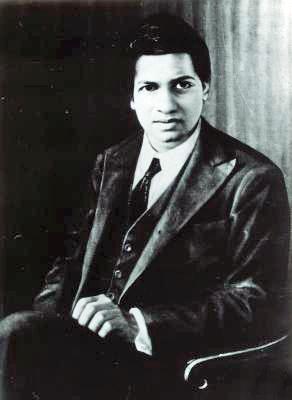 |
| Srinivasa Ramanujan |
While on his death-bed in 1920, Ramanujan wrote a letter to his mentor, English mathematician G. H. Hardy. The letter described several new functions that behaved differently from known theta functions, or modular forms, and yet closely mimicked them. Ramanujan conjectured that his mock modular forms corresponded to the ordinary modular forms earlier identified by Carl Jacobi, and that both would wind up with similar outputs for roots of 1.
No one at the time understood what Ramanujan was talking about. “It wasn’t until 2002, through the work of Sander Zwegers, that we had a description of the functions that Ramanujan was writing about in 1920,” Ono says.
Building on that description, Ono and his colleagues went a step further. They drew on modern mathematical tools that had not been developed before Ramanujan’s death to prove that a mock modular form could be computed just as Ramanujan predicted. They found that while the outputs of a mock modular form shoot off into enormous numbers, the corresponding ordinary modular form expands at close to the same rate. So when you add up the two outputs or, in some cases, subtract them from one another, the result is a relatively small number, such as four, in the simplest case.
“We proved that Ramanujan was right,” Ono says. “We found the formula explaining one of the visions that he believed came from his goddess.”

“No one was talking about black holes back in the 1920s when Ramanujan
first came up with mock modular forms, and yet, his work may unlock
secrets about them,” Ono says.
Ono uses a “magic coin” analogy to illustrate the complexity of Ramanujan’s vision. Imagine that Jacobi, who discovered the original modular forms, and Ramanujan are contemporaries and go shopping together. They each spend a coin in the same shop. Each of their coins goes on a different journey, traveling through different hands, shops and cities.
“For months, the paths of the two coins look chaotic, like they aren’t doing anything in unison,” Ono says. “But eventually Ramanujan’s coin starts mocking, or trailing, Jacobi’s coin. After a year, the two coins end up very near one another: In the same town, in the same shop, in the same cash register, about four inches apart.”
Ramanujan experienced such extraordinary insights in an innocent way, simply appreciating the beauty of the math, without seeking practical applications for them.
“No one was talking about black holes back in the 1920s when Ramanujan first came up with mock modular forms, and yet, his work may unlock secrets about them,” Ono says.
Expansion of modular forms is one of the fundamental tools for computing the entropy of a modular black hole. Some black holes, however, are not modular, but the new formula based on Ramanujan’s vision may allow physicists to compute their entropy as though they were.
Watch the trailer to a forthcoming film about the life of Ramanujan:
After coming up with the formula for computing a mock modular form, Ono wanted to put some icing on the cake for the 125th-anniversary celebration. He and Emory graduate students Michael Griffin and Larry Rolen revisited the paragraph in Ramanujan’s last letter that gave a vague description for how he arrived at the functions. That one paragraph has inspired hundreds of papers by mathematicians, who have pondered its hidden meaning for eight decades.
“So much of what Ramanujan offers comes from mysterious words and strange formulas that seem to defy mathematical sense,” Ono says. “Although we had a definition from 2002 for Ramanujan’s functions, it was still unclear how it related to Ramanujan’s awkward and imprecise definition.”
Ono and his students finally saw the meaning behind the puzzling paragraph, and a way to link it to the modern definition. “We developed a theorem that shows that the bizarre methodology he used to construct his examples is correct,” Ono says. “For the first time, we can prove that the exotic functions that Ramanujan conjured in his death-bed letter behave exactly as he said they would, in every case.”

A highlight of working on a film about Ramanujan's life was getting to browse through some of the Indian master's original notebooks, says Ono, above right.
Although Ramanujan received little formal training in math, and died at the age of 32, he made major contributions to number theory and many other areas of math.
In the fall, Ono traveled to Ramanujan’s home in Madras, and to other significant sites in the Indian mathematician’s life, to participate in a docu-drama. Ono acted as a math consultant, and also has a speaking part in the film about Ramanujan, directed by Nandan Kudhyadi and set to premiere next year.
“I got to hold some of Ramanujan’s original notebooks, and it felt like I was talking to him,” Ono says. “The pages were yellow and falling apart, but they are filled with formulas and class invariants, amazing visions that are hard to describe, and no indication of how he came up with them.”
Ono will spend much of December in India, taking overnight trains to Mysore, Bangalore, Chennai and New Dehli, as part of a group of distinguished mathematicians giving talks about Ramanujan in the lead-up to the anniversary date.
“Ramanujan is a hero in India so it’s kind of like a math rock tour,” Ono says, adding, “I’m his biggest fan. My professional life is inescapably intertwined with Ramanujan. Many of the mathematical objects that I think about so profoundly were anticipated by him. I’m so glad that he existed.”
Related:
New theories reveal the nature of numbers
A surprise dimension to adding and counting
How a hike in the woods led to a math 'Eurkea!'
Image credits: Hindu temple by iStockphoto.com; Ramanujan photo via Oberwolfach Photo Collection/Konrad Jacobs; black hole simulation by NASA, M. Weiss (Chandra X-Ray Center); bottom photo courtesy of Ken Ono.
Monday, December 10, 2012
Aladdin to Lincoln: How stories shape a life
The tales that we read, and the tales that we spin about ourselves, play a role in helping us realize our full potential, says Jordan Greenwald, who gave a TEDxEmory talk last spring (see above video) as an Emory senior, majoring in psychology.
Greenwald counts stories of both the fictional Aladdin, and the real-life Abraham Lincoln as strong influences in shaping his own life.
“Stories give us an emotional education, “ Greenwald says. “If we don’t address this inner world of dreams, desires, anxieties, we risk meandering, which really means forfeiting who we could become.”
Related:
Prometheus: Seeding wonder and science
Stories your parents should have told you
Tuesday, December 4, 2012
Uganda closing in on river blindness

In 2007, Uganda announced a bold plan to eliminate river blindness by 2020. The Carter Center’s Moses Katabarwa, a graduate of Emory’s Rollins School of Public Health, has been in the battle from the beginning— and he believes they’re going to win. Photos by Kay Hinton.
By Paige Parvin, Emory Magazine
The River Nile is the longest in the world, moving mightily over more than four thousand miles and through ten African countries before emptying itself into the Mediterranean Sea. For millions it is the source of life and legend, death and mystery, symbol and song—not to mention water, food, transportation, and money. It is at once mythic and utterly real, visible from space and from bridges, banks, and boats.
As the matriarch of Uganda’s many rivers and streams, the Nile holds innumerable secrets, including a tiny black fly that breeds only in swift-moving waters and carries inside it the makings of a particular sort of human misery: onchocerciasis, or river blindness.

It’s this fly that Moses Katabarwa, a Uganda native and senior epidemiologist for The Carter Center’s River Blindness Program, has been chasing for more than 20 years. The black fly Simulium—about the size of a Georgia gnat—is unusual in its preference for moving water, since so many of its brethren pests like to breed in warm, stagnant puddles and ponds. Two different types of the fly carry the river blindness parasite, Onchocerca volvulus—one, S. damnosum, dives into flowing waters to lay its eggs, shooting them from its tiny body bundled in a superglue-like substance that sticks them firmly to underwater rocks or vegetation. The other, S. neavei, can lay eggs only in small river crabs and has a shorter flight range than its wily cousin.
When people are bitten by female flies (the males don’t bite), they can become infected with onchocerciasis microfilaria, pre-larval-stage parasitic worms that wriggle their way around under the skin. Like the Guinea worm parasite—another of The Carter Center’s targeted diseases—these worms can breed inside the body; they multiply and sometimes form writhing nodules that can be felt and even seen.

And they love to migrate up to the eye, where they cause irritation and nerve damage, and eventually, as they die, leave debris that can build up to the point of diminished vision and permanent blindness. Affecting some eighteen million people in Africa and the Americas, the disease is the second-leading cause of preventable blindness in the world.
River blindness infection triggers an immune response similar to that of an allergic reaction, which is why it causes intense itching, swelling, rashes, lesions, and skin discoloration—a pattern commonly referred to as “leopard skin.” Ironically, a strong immune system can produce a more severe reaction.
“If you have an efficient immune system, you will suffer much more,” says Katabarwa. “The more you scratch, the more you want to.”
It takes many fly bites to produce a bad infection—what health workers offhandedly call a high “worm load”—but in rural villages that are situated near swift-moving rivers and streams, it’s not hard to become bait.
Read more in Emory Magazine.
Related:
On the trail of black flies
Tuesday, November 27, 2012
Psychedelics, the brain and shamanism
“Call upon me, for I am the black jaguar. It is me you must evoke if you wish to scare the illness away.” These words of a Brazilian shaman describe the ancient practice of creating a charismatic intermediary with the divine.
In the above video, Emory art historian Rebecca Stone gives a brief overview of an ongoing exhibit at the Carlos Museum, “For I Am the Black Jaguar,” that explores shamanism through art, zoology, botany, religion and anthropology.
The trances that transformed shamans into totems like jaguars and whale sharks were brought about in part by the ingestion of etheogenic substances. Psychiatrists Katherine MacLean and Charles Raison will discuss what happens in the brain during these trances in a special lecture at the museum, on Thursday, November 29 at 7:30 pm.
Related:
Tapping traditional remedies to fight modern super bugs
Subscribe to:
Posts (Atom)