Monday, March 16, 2015

Taking hands-on mentoring to new heights


By Marsha Walton, via AAAS

Emory biology professor Patricia Marsteller makes it clear to students of all ages that they can change the world at any time. And it doesn’t have to be a big gesture.

At the Center for Science Education (CSE), she helps create hands-on research and curriculum for students and teachers at the pre-college, college and postgrad levels. With one local grant, for example, her team of science educators worked with high school students to make connections between science and the arts.

Pat Marsteller
Another school wanted to use science to learn more about homelessness in metropolitan Atlanta. “The students actually went out and talked with homeless people under bridges, with help from grad students and teachers. But then they decided they wanted to do something about it. They used their science class to build little solar heaters for homeless people. So they could see right there where they could make a difference,” she said.

Marsteller, a AAAS fellow, joined the Emory faculty in 1990 with a focus on bringing more women and minorities to biology and medicine. Today, her mission has broadened to improving science education by mentoring learners from “K through gray.” And she says doing that well literally takes a “hands-on” approach.

One of her liveliest examples? On day one of the class Biology, Physics, Chemistry and Design Principles of Coffee and Beer, Emory students dissected the workings of coffeemakers rescued from yard sales. “We had them take them apart, and try to explain how they worked,” said Marsteller. “They were just astonished. None of them had ever done anything like that before. But it grabbed them.”

She says students who are academic stars—but who have never taken apart a tractor, car or other machinery—may be missing the problem-solving experience that’s crucial for developing a scientific mindset. “They can learn facts and spit them back at you, but that is not what we want them to do. We want them to find new ways of doing things. The science changes all the time and they need to learn to investigate claims on their own,” she said.

Marsteller grew up on a farm in Pennsylvania, the oldest of 11 children. All those siblings and animals gave her plenty of chances for hands-on, unscripted learning. Although she was first headed toward a career as a physician, her interest began shifting toward research and science education after a discouraging undergraduate experience. “I encountered some really bad teaching,” she said.

Her search for her own scientific future became a wide one, ranging from clinical research in pediatric cardiology to analyzing cattle nutrition.


But it was volunteer work with alligators at the Savannah River Ecology Laboratory in South Carolina that intrigued her so much that it galvanized her scientific focus on research and teaching. She studied evolution of animal behavior and genetics for her graduate degrees, including the study of an alligator’s ability to use celestial navigation. “We kept finding that if you relocated an alligator, even hundreds of miles away, they would find their way back home. Well, how do they do that?” she said.

Her own captivation with reptile research early in her career inspires her to guide students to find their passion, even if it takes them in a whole new direction from where they started. She describes herself as a “change agent” and “transformer.”

As director of CSE, she helps undergraduates with that quest with a simple exercise. “It’s like a Venn diagram. There are three circles: What are you good at? What do you like to do? What will make a difference in the world?”

She says students who soar in the sciences often are channeled into medical careers, for financial security or to make their parents happy. She stresses that scientists in other specialties can make practical things happen through research.

One of her proud creations is the SURE program, the Summer Research Experience at Emory. Undergrads from Emory and other schools are paired with grad students for summer projects. Most go on to succeed in graduate programs.

While attracting women and underserved students has shown success, Marsteller says creating diversity among science faculties has been painfully slow and frustrating. “People on the search committees write to their friends, and their friends all look like them,” she said, adding that more of an effort needs to be made by major institutions to stay in touch with successful alumni with PhDs and bring them back to join the faculty.


Marsteller is convinced that mentors are the key to success at every level of STEM education. “There needs to be a kind of cascade of mentoring, from faculty to postdoc to undergrad to high school. And not just for research, but for professional development, for strategy in launching a career,” she said.

Marsteller also helps her students bring scientific understanding to the public about some of today’s critical issues, including climate change, population growth and sustainable energy. She encourages them to reach out in coffee shops, bars, or botanical gardens. She says podcasts, websites, and public talks have just “taken off” with popular support. “I think we can engage people from all walks of life into thinking about these issues,” she said.

Whether it is staring down a baby alligator, reimagining a coffeemaker, or embarking on a nontraditional scientific quest, Marsteller is a vocal advocate and example of the rewards of following the path that is most inspiring. “Students need that nourishing and pushing a little bit,” she said.

Copyright by AAAS, used with permission.

Related:
Cultivating brains for science
Bringing new blood to high school science

Tuesday, March 10, 2015

Disease poses risk to chimpanzee conservation, Gombe study finds

Gombe is the site where Jane Goodall conducted her pioneering research into the behavior of wild chimpanzees, beginning in 1960. "If we’re going to keep these iconic chimpanzees on the planet, we need to address the spread of infectious diseases," says disease ecologist Thomas Gillespie.

By Carol Clark

Infectious disease should be a key consideration in wildlife conservation, suggests a study focused on primates in Tanzania’s Gombe Stream National Park, published by PLOS Neglected Tropical Diseases. The study investigated the parasite Cryptosporidium and cross-species transmission risks among humans, wild primates and domesticated animals within the greater Gombe ecosystem.

“We found that people are likely exposing the endangered chimpanzees of Gombe to a particular species of Cryptosporidium, which may be contributing to their decline,” says Michele Parsons, a PhD student in Emory University’s departments of Environmental Sciences and Environmental Health. “It appears to be a case of spillover, or exchange of a pathogen, from humans to animals, instead of the other way around.”

The spillover of any one pathogen between species, Parson adds, “is an indicator that an ecological connection exists, with potential for other pathogens to emerge.”

The study also revealed that some of the chimpanzees are infected with a species of Cryptosporidium associated with pigs. “No domesticated pigs reside in the village just outside the park, so we think it’s likely that the source of infection is wild pigs living in the forest,” Parsons says.

In addition to being a student in Emory’s Population Biology, Ecology and Evolution Graduate Program, Parsons is a research microbiologist at the Centers for Disease Control and Prevention’s Division of Foodborne, Waterborne and Environmental Diseases. She led the study with her PdD adviser, disease ecologist Thomas Gillespie, a professor in Emory’s Department of Environmental Sciences and Rollins School of Public Health’s Department of Environmental Health.

“When it comes to protecting endangered species, the focus is often limited to providing habitat and preventing hunting,” Gillespie says. “But disease also matters in conservation, and that’s a relatively new message. Our research shows that if we’re going to keep these iconic chimpanzees on the planet, we need to address the spread of infectious diseases.”

Gombe is the site where Jane Goodall conducted her pioneering research into the behavior of wild chimpanzees, beginning in 1960. Goodall’s project is now the longest field study of any animal. Each individual chimpanzee has been identified, and its maternal line is known.

Despite the fact that Gombe became a protected wildlife park in 1968, the chimpanzee population there is on the decline, down from about 150 chimpanzees 20 years ago to 100 today.

Emory disease ecologists Michele Parsons and Thomas Gillespie in the field in Gombe.

The Gillespie lab is one of the few investigating the ecology and epidemiology of infectious disease in natural systems where domesticated animals, humans and wildlife overlap.

Cryptosporidium, or "Crypto," is one of the most frequent causes of waterborne disease in the United States, and is among the top four cases of moderate-to-severe diarrheal disease in young children in developing nations. Crypto is particularly dangerous for people infected with HIV, who tend to have more severe cases that can be fatal. Studies have also shown that chimpanzees infected with SIV (the ancestor of HIV) have a reduced lifespan and may be more vulnerable to opportunistic infections.

The researchers collected fecal samples from a cross-section of chimpanzees, baboons, humans, and domesticated dogs, goats and sheep within the greater Gombe ecosystem. The results revealed Crypto infection rates of about 16 percent in the wild primates, 4 percent in humans and 10 percent in the goats and sheep.

DNA sequencing uncovered a complex epidemiology for Crypto in this system, with humans, baboons and a subset of chimpanzees infected with C. hominis (which is most closely associated with humans), and another subset of chimpanzees infected with C. suis, (usually associated with pigs). All the positive sheep and goats were infected with C. xiaoi (a subtype associated with livestock).

“The dominance of C. hominis among humans and non-human primates suggest cross-species contamination,” the study authors write.

The research team gathers stream water samples for analysis.

The baboons are known to raid human homes and trash for food, while the chimpanzees raid agricultural fields just outside the park boundaries. These behaviors expose the wild primates to the potentially contaminated feces of livestock or exposed human sewage.

Although water samples screened in the study were negative for Crypto, waterborne outbreaks of Crypto as a result of human and animal fecal contamination are common. “Homes with positive livestock had a tendency for increased risk of human infection, suggesting contribution of environmental factors or behaviors that may place the household at increased risk,” the study authors write.

The findings highlight the complex nature of zoonotic parasite transmission and stress the need for further studies, Parsons says. “It’s important to understand the ecology of diseases for both wildlife conservation and for human health. We need good baseline data in order to monitor emerging pathogens.”

Co-authors of the study include researchers from the University of Minnesota, Franklin and Marshall College, the Jane Goodall Institute and the Henan Center for Disease Control and Prevention.

Photos courtesy of Thomas Gillespie and Michele Parsons

Related:
Field notes: Attack of the siafu ants
Ebola's back story: How germs jump species
Sanctuary chimps show high rates of drug-resistant staph

Monday, March 9, 2015

Seeing people in a Congolese aid camp in a new way

All the photographs in Aubrey Graham's exhibition "Disneyland" are active collaborations between herself and the people being portrayed.

By Carol Clark

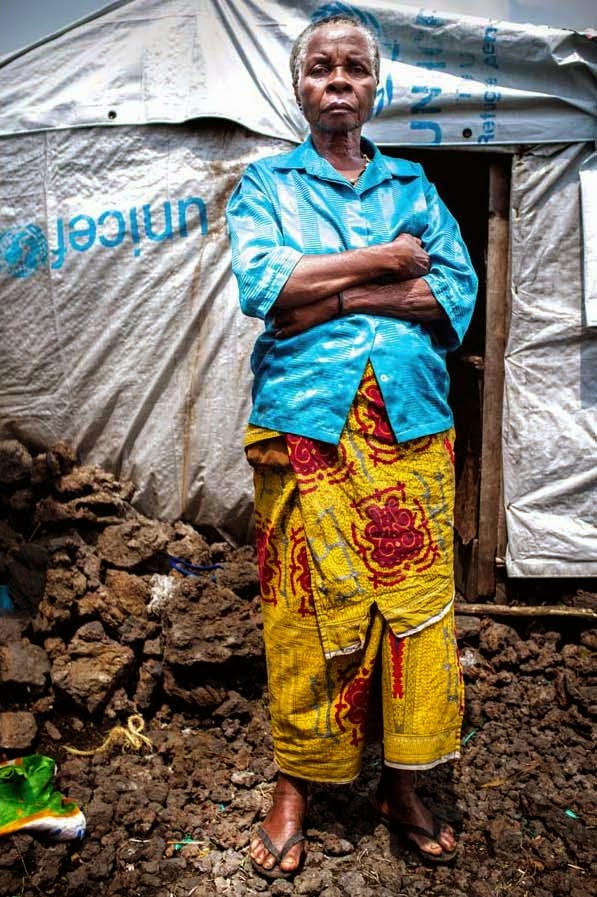
“I sat down with Marciella on some rocks in front of her house and had a chat, I asked her how she wanted to be represented,” recalls Aubrey Graham, a photographer and a PhD candidate in anthropology at Emory. “She said that she wanted to be shown suffering, no question about that. So I asked her how she wanted to portray her suffering. She took her beautiful headscarf off to show her gray hair and clasped her hands to her face. It was quite dramatic.”

Marciella was thrilled with the resulting photographs (above and right), says Graham. The striking images are part of an exhibition of Graham’s photographs on the ground floor of the Emory Center for Ethics, where Graham is currently an artist-in-residence through the Ethics and Arts Program. She will be giving a talk on the exhibition at noon on Wednesday, April 15, in the Center for Ethics, room 102.

“Portraits in Disneyland: Stories of Mugunga III,” on view through May, consists of photos that Graham made in collaboration with internally displaced people in a camp near the humanitarian hub of Goma, in the eastern Democratic Republic of the Congo (DRC). Graham describes the camp, known as Mugunga III, as having “been visited and photographed by nearly every errant aid worker, VIP, celebrity and journalist who arrives in the region – to the degree that its frustrated coordinators casually dubbed it ‘Disneyland.’”

Graham spent a year in the DRC, including eight months creating the images. “The change over time was amazing,” she says. “You get looped into peoples' lives in really intricate and wonderful ways. I loved getting invited back to photograph the progression of a pregnant woman, then her newborn, and then the baby sitting up.”

Though Marciella wanted to show herself as “suffering,” other subjects wanted to be portrayed with a prize possession, such as a radio, or going happily about their daily routine, surrounded by the people they care about most.

“I want to unsettle how we think about life in those camps and the people in them,” Graham says. “They are not always miserable.”

Her original question was: What are the implications of humanitarian photography in a region saturated with aid for over 20 years? “Through my research,” she says, “that question has expanded to look at both local Congolese and humanitarian photographic practices to understand the broader implications of photography upon identity and the politics of the region.”

To learn more about Graham’s project, read this Q&A with her on the Laney Graduate School web site.

Thursday, February 26, 2015

Why debunked autism treatment fads persist

The emotional appeal of facilitated communication is "very powerful and understandable," says psychologist Scott Lilienfeld. "The problem is, it doesn't work."

By Carol Clark

The communication struggles of children with autism spectrum disorder can drive parents and educators to try anything to understand their thoughts, needs and wants. Unfortunately, specialists in psychology and communication disorders do not always communicate the latest science so well.

These factors make the autism community especially vulnerable to interventions and “therapies” that have been thoroughly discredited, says Scott Lilienfeld, a psychologist at Emory University.

“Hope is a great thing, I’m a strong believer in it,” Lilienfeld says. “But the false hope buoyed by discredited therapies can be cruel, and it may prevent people from trying an intervention that actually could deliver benefits.”

Lilienfeld is lead author of a commentary, “The persistence of fad interventions in the face of negative scientific evidence: Facilitated communication for autism as a case example,” recently published by the journal Evidence-Based Communication Assessment and Intervention. Co-authors of the commentary are Julia Marshall (also from Emory) and psychologists James Todd (from Eastern Michigan University), and Howard Shane (director of the Autism Language Program at Boston Children’s Hospital).

The authors describe a litany of treatments for autism that have been attempted with little or no success over the years, including gluten- and casein-free diets, antifungal interventions, chelation therapy, magnetic shoe inserts, hyperbaric oxygen sessions, weighted vests, bleach enemas, sheep-stem-cell injections and many more.

As a case study, however, the article focuses on one intervention in particular: Facilitated Communication, or FC.

FC purports to allow previously nonverbal individuals with autism and related disorders to type by using a keyboard or letter pad. A facilitator offers support to the individual’s arms, allowing him or her to type words and complete sentences.

Soon after its introduction into the United States in the early 1990s, however, FC was convincingly debunked. Studies overwhelmingly demonstrated that facilitators were unconsciously guiding the hands of individuals with autism toward the desired letters, much as individuals using a Ouija board unknowingly guide the planchette to certain numbers and letters.

“The emotional appeal of FC is very powerful and understandable,” Lilienfeld says. “And no doubt the overwhelming majority of people who use FC are sincere and well-meaning. The problem is, it doesn’t work.”

In some cases, the authors note, FC has resurfaced with minor variations in the technique and a new name, such as “rapid prompting,” or “supported typing.”

By reviewing published surveys of practitioner use and canvassing the popular and academic literatures, Lilienfeld and his co-authors show that FC continues to be widely used and widely disseminated in much of the autism community despite its scientific refutation. They examine a number of potential reasons for the surprising persistence of FC and other autism fads. They note that the inherent difficulties in treating autism may give rise to an understandable desire for quick fixes of many kinds.

Lilienfeld and his colleagues underscore the pressing need for experts in the autism field to better educate the public about not only what works for the condition, but what does not.

Related:
Top 10 facts about non-verbal communication
Anxious children confuse 'mad' and 'sad' faces

Tuesday, February 24, 2015

Poison power: From Cleopatra to Cyclops


Why did Cleopatra choose to be bitten by a poisonous snake when she had access to any number of plant poisons to commit suicide?

In the video above, Emory ethnobotanist Cassandra Quave explains how the Egyptian queen experimented before picking her poison. She also describes how the myth of Cyclops may have originated from the effects of a medicinal herb.

Poison has shaped history, myth and medicine in myriad ways. Over time, people have discovered ingenious ways to transform and make use of plant poisons for use in agriculture, fishing, hunting and medicine. Learn more about how poison plants are used in medicine in the video below.

Quave, an expert in the interactions of people and plants, and an assistant professor of dermatology in Emory’s School of Medicine, is among a lineup of guest lecturers at the Fernbank Museum, in conjunction with the special exhibition "The Power of Poison," continuing through May 1.


Related:
Tapping traditional remedies to fight modern super bugs