Showing posts sorted by relevance for query dreams. Sort by date Show all posts

Tuesday, May 10, 2011

'Where you have friction, changes can occur'


"Molecular diversity underpins both the structural intricacy of biology, as well as the complexity of our ideas and dreams," Lynn says.

By Carol Clark

"My brother liked to build models. And I liked to blow them up," recalls David Lynn, chair of Emory's chemistry department and the Asa Griggs Candler Professor of Chemistry and Biology.

Their childhood experiments led to his brother's career as a building contractor and Lynn's as a groundbreaking chemist who is not afraid to make sparks fly. "The joke in the family is, it's a good thing that we no longer collaborate," Lynn says.

Lynn received the 2011 University Scholar/Teacher Award, selected by Emory faculty on behalf of the United Methodist Church Board of Higher Education and Ministry. He was recognized for his contributions to plant chemical biology, dynamic molecular self-assembly, chemical evolution and chemical education.

Lynn's chemical interests grew beyond explosions while he was a college student in North Carolina. "One day, I walked out of an organic chemistry class and I noticed a leaf on a tree branch that was hanging over a banister," he says. "I thought, ‘That leaf is coordinating billions of reactions going on all the time.' I remember marveling at that, and I've never stopped marveling."

That simple insight drove Lynn to focus on how order comes from chaos. After joining Emory in 2000, he helped establish the Center for Chemical Evolution, a collaboration between Emory, Georgia Tech and other institutions, funded by the National Science Foundation and NASA. The center is testing theories for how chemical reactions may have led to life emerging from Earth's primordial soup, some 3.5 billion years ago.

In 2002, he received the Howard Hughes Medical Institute award, worth $1 million. He used the funds to create a program called On Recent Discoveries by Emory Researchers (ORDER), a series of seminars where graduate students teach freshmen.

"Rather than just spending 24/7 in a lab, graduate students need to put their research into a broader context and learn to explain it to the public," Lynn says of the philosophy behind ORDER. An added benefit of the program is exposing freshmen to the possibilities of a career in academia, nurturing growth of the research community, Lynn says.

Lynn is also committed to helping the lay public understand the ongoing research into the evolution of life, and its relevance to modern-day life. Atlanta is an interesting location to focus on this goal, he says, since it is the epicenter of the debate between science and religion.

"This is where the friction is, and where you have friction, that's where changes can occur," he explains.

Both religion and science strive to make sense of the world, Lynn says. Rather than reciting facts that demonstrate evolution, Lynn believes that the best way to help people understand it is through compelling stories. He has helped pioneer collaborations between Emory scientists and playwrights, dancers and other artists. The recent performances of a science flash mob in downtown Atlanta, using a group of people to show how molecules evolve, is one example of this daring convergence of science and art.

"Sixty percent of Americans don't accept the tenants of evolution because they don't see them as part of their experience," Lynn says. "So somehow we need to find ways to create space for a dialogue. If there is one lesson that emerges from the study of chemical evolution, it is that molecular diversity underpins both the structural intricacy of biology, as well as the complexity of our ideas and dreams."

Related:
The missing link to life?
Flash your intelligence
Doctorate's ORDER: Teach your research

Monday, July 9, 2018

Science on stage: Atlanta playwrights explore the human microbiome

Learning about the microbiome "is shifting my perspective of what it means to be human and an individual," says playwright Margaret Baldwin. "What bacteria are driving our dreams?"

Four Atlanta playwrights + 48 hours = four new plays at the forefront of art and science.

That’s the premise of Theater Emory’s “ 4:48,” a frenetic yet focused showcase of new works inspired by the human microbiome that will be performed July 14 at the Schwartz Center for Performing Arts.

The annual speed-writing challenge always yields compelling results, as talented local playwrights come together at Emory to quickly produce plays based on common source material. But this year, for the first time, the Playwriting Center of Theater Emory is teaming up with the Emory Center for the Study of Human Health for “4:48” — an innovative, interdisciplinary collaboration that promises to push the boundaries of both fields.

“Theater offers an exciting communication mechanism to convey cutting edge-research findings to a wide audience, while simultaneously encouraging curiosity and imagination,” says Amanda Freeman, instructor in the Center for the Study of Human Health.

The collaborators hope that this project will introduce the human microbiome — the trillions of microorganisms that live in us and on us — to a whole new audience, providing a spotlight for research that is being done right here on campus.

“I have found very few venues where new science and new art can emerge from a single exercise, so ‘4:48’ is special,” says David Lynn, Asa Griggs Candler Professor of Chemistry and Biology, one of several Emory science faculty offering support as resources for the writers.

Readings of the work developed during "4:48" begin at 4 pm on Saturday, July 14, in the Theater Lab of Schwartz Center. All readings are free and open to the public. For the schedule of readings and play titles, visit the Theater Emory website.

Click here to learn more.

Related:
Learning to love our bugs: Meet the microorganisms that help keep us healthy
Environment, the microbiome and preterm birth

Wednesday, May 13, 2015

Graduate strives to help female scientists in Africa

Emory graduate Kwadwo "Kojo" Sarpong, a native of Ghana, felt compelled to do something about the opportunity gap in Africa between men and women scientists. Emory Photo/Video.

By Kimber Williams, Emory Report

When a White House invitation to the first U.S.-Africa Leaders Summit showed up in his email last year, Emory senior Kwadwo Sarpong didn’t give it much thought. “I honestly thought it was some kind of a joke,” says Sarpong, who graduated from Emory this month with a degree in neuroscience and behavioral biology (NBB). 

But when a second invitation soon followed, Sarpong took notice.

“The Obama Administration’s Office of Public Engagement was interested in what I was doing to bridge the opportunity gap between male and female scientists in Africa,” explains Sarpong, who is known to his friends as “Kojo.”

That’s how Sarpong, who is from Ghana, found himself attending an event with top African officials, international leaders and U.S. cabinet members, where he represented the African Research Academies for Women (ARA-W), an organization that he co-founded to nurture the interests of aspiring female scientists in Africa by providing hands-on experience in research laboratories.

Sarpong arrived in Atlanta in 2009 with one goal: education.

Growing up in Ghana, the youngest of four boys, he was deeply aware of shortcomings within the nation’s healthcare system. When one of his brothers became ill with paralytic polio, he recalls that some blamed it on evil spirits.

Stricken with severe fevers while growing up, Sarpong spent considerable time in hospitals himself, an experience that would feed a budding interest in medicine.

During his first year of studies at the University of Ghana, Sarpong was thrilled to learn he’d “won a green card” and the chance to travel to the U.S. “Like a lot of African students, I had very high hopes and dreams — I was going to transfer directly into an American university,” he recalls, smiling. “Instead, I ended up living with my cousin in Atlanta and working as a housekeeper at a medical center and a cashier and warehouse associate at Walmart.”

As friends back in Ghana were preparing to graduate from college, Sarpong studied their Facebook photos. While their lives were moving forward, his seemed stuck. “Everybody thinks that you come to America and your life will change,” Sarpong says. “I was beginning to wonder if I had made a mistake.”

In time, he began taking classes in chemistry at Georgia Perimeter College. Motivated by his brother’s experience with polio, “I became very interested in neuroscience,” he says.

With the help of Emory’s Initiative to Maximize Student Development — a program funded by the National Institutes of Health to expand scientific workforce diversity — Sarpong arrived as a transfer student in Fall 2013.

Talking about his experiences one day with a friend who had graduated from the University of Ghana, he was shocked to learn that she had taken a job as a bank teller — the only position she could find. “There is nothing here for women in science,” she told him.

Sarpong felt compelled to do something about the opportunity gap that exists in Ghana — and much of the developing world — between men and women in the sciences. “Ghana is still a male-dominated culture,” he explains. “I began thinking about what I could do to create social change with something I really love — research.”

Read more in Emory Report.

Tuesday, June 24, 2014

From baseball to dogs and the field of his dreams

Having a ball: Brian Hare with his dog Tasmania. Hare began researching dogs as an undergraduate at Emory and went on to found the Canine Cognition Center at Duke University. (Photo by Nick Pironio.)

By Paige Parvin, Emory Magazine

As an Emory undergraduate in the 1990s, Brian Hare led and published a study showing that dogs can follow a human hand pointing—something that chimpanzees, longtime stars of cognitive research, were much less capable of doing.

It all started when Hare didn’t make the baseball team.

An Atlanta native, Hare attended the Lovett School, where he claims he was “not a particularly good student.” But he did get the chance to intern at Zoo Atlanta, working with drills, baboon-like primates who evolved to have dramatically colorful rear ends so their companions could follow them in the jungle.

So when he arrived at Emory (which his mother and uncle also attended), “I was already really excited about animal behavior and studying primates,” Hare says.

He was also really excited about baseball—what he calls his first love. When he wasn’t allowed to try out for the Emory team because he was three minutes late to practice, it was a crushing blow. “But it was actually the hugest favor anyone ever did for me,” Hare says. “Because it gave me a year to think about it, and meanwhile I took classes with professors like Frans de Waal and discovered that I really loved psychology and evolutionary anthropology and studying primate behavior and cognition. I was hooked.”

In his sophomore year, Hare met Michael Tomasello, then a professor of psychology. That connection was a game changer. Tomasello immediately recognized Hare’s spark, and kindled it by encouraging him to participate in serious research. Hare was blown away.

“We had one conversation, and he said, here’s an idea we’ve been thinking about for a research project. What do you think?” Hare says. “And I was like, what? Did he just ask me what I think? This is the coolest guy I have ever met in my life. Right from the beginning, I was part of the team.”

At the same time, Hare had a choice to make about another team—the Emory baseball team, which was holding fall tryouts again. “I was this eighteen-, nineteen-year-old, starting to realize what science is really all about,” he says. “I was like, wait, you want to study animals to better understand people? I didn’t even know people did that. I had a new love. So the calculation was this—I could try out for baseball, maybe sit on the bench, or I could work with Mike Tomasello and do what I actually thought might be my dream. I could play science like I thought I was going to play baseball. So that’s what I did. I played science like other people play sports.”

Hare’s next breakthrough moment came when he started studying dogs.

Read the whole article in Emory Magazine.

Related:
What is your dog thinking? Brain scans unleash canine secrets
How dogs love us

Monday, September 30, 2013

Celebrating 50 years of psychology at Emory

The old psychology building on the Quad, which served as headquarters for the department for decades.

By Carol Clark

In 387 BC, Plato proclaimed that the brain is the seat of mental processes. In 335 BC, Aristotle countered that all emotions originate in the heart, opening classical debates about the human mind and behavior.

“And the conversation continues,” said Marshall Duke, Candler Professor of Psychology.

Nowhere is that conversation livelier than Emory’s Department of Psychology, which recently celebrated its 50th year in its modern form with presentations on its evolution. Clinical work and research into depression, schizophrenia, autism-spectrum disorders, early childhood development, the mental health of families and the origins of human morality — those are a few of the areas in which Emory has, and continues, to make major contributions.

Duke, who joined the Emory faculty in 1970, kicked things off with a talk that sped through centuries of science.

During the 1830s, as German physician Ernst Weber laid a foundation for experimental psychology with his law of “just notable differences,” Emory College was founded.
Diagram of Phineas Gage's injury.

During the 1840s, Emory handed out its first diplomas and “Phineas Gage got impaled and his personality changed,” said Duke. Gage was a Vermont railroad worker, whose horrific injury revealed how damage to a specific area of the brain changes behavior.

Fast-forward to the 1860s, when Emory temporarily closed to serve as a Civil War barracks and hospital. Keep moving through the decades as scientists in Europe identified the Broca and Wernicke areas of the brain, data-based psychology began, Freud published his “Interpretation of Dreams” and Pavlov experimented with his dogs.

In 1911, a “professor of mental science” joined the Emory faculty, and in 1919, the college moved from Oxford, Georgia, to Atlanta.

Goodrich C. White, a native Georgian who graduated from Emory in 1908, returned as Emory’s first professor of psychology in 1927. “He ultimately became the dean of psychology and later the president of the university,” Duke said. “He transformed this place.”

Under White’s leadership, the college grew into a university. Emory launched graduate degree programs (psychology’s began in 1957) and acquired what is now called the Yerkes National Primate Research Center.
Goodrich C. White


Meanwhile, clinical psychology came of age in the aftermath of World War II. Long before the term post-traumatic stress disorder was coined, the Veteran’s Administration recognized it needed help offering mental health care to returning soldiers and began investing in university’s that offered applied, clinical programs.

During the 1960s, Irwin Jay Knopf was named Emory’s chair of psychology, charged with establishing a department of the first rank. The newly formed department established the basis of three programs that are today known as Clinical Psychology, Neuroscience and Animal Behavior and Cognition and Development.

“The modern era began,” Duke said.

Stephen Nowicki, Emeritus and Candler Professor of Psychology, joined the clinical program in 1969. “The history of the clinical program is also my history. I lived it,” Nowicki said in his presentation. “I have met and worked with all of the people who have ever been on the faculty then or are on it now. We have much to be proud of in the clinical psychology program. We have built a tradition of excellence that rivals any program in the country.”

Over the years, the faculty has published more than 1,000 studies and dozens of books. More than 300 of their students have completed their clinical PhDs and have gone on to impact all aspects of clinical psychology, spread over 40 states and five foreign countries.

Polaroid snaps from 1975 show long-time friends and colleagues Duke and Nowicki, left, and faculty and students in front of the old psychology building.

But it wasn’t all work, Nowicki recalled. Early in the department’s formation many members of the psychology faculty were not much older than their students. “I think we had more fun, or at least we did different things for fun than faculty and students do now,” he said.

Among his most vivid memories was the clinical program’s annual gong show. “I remember a faculty member dancing in a tutu, an ugly dog named Pepper who supposedly was dressed as Linda Lovelace form the pornographic movie “Deep Throat,” and my all-time favorite, the Egg Man. He put his egg cartons down, took off his tie, and then proceeded to take one egg at a time and crush it against his body to the cheers of the audience.”

Darryl Neill, Goodrich C. White Professor of Psychology, talked about how he studied “biopsychology” at the University of Chicago, to become what was then known as a “physiological psychologist.”

When Neill joined the budding Neuroscience and Animal Behavior program at Emory in 1971, he recalled that the department had much less emphasis on biology and animal research. The NAB program has since grown to comprise about 30 percent of the department’s research, Neill said.

Last spring, the department opened the Facility for Education and Research in Neuroscience, housing a Siemens Trio 3-Telsa functional magnetic resonance imaging (fMRI) machine. Known as FERN, the facility is geared for using fMRI to explore the neural mechanisms of thoughts and behaviors, while also training students and faculty in the technology.

“We’ve made it,” Neill said of the burgeoning field of neuroscience. “We’re so successful, that the backlash is under way.”

He noted that Emory psychology professor Scott Lilienfeld is among the neuro-critics. Lilienfeld recently co-authored “Brainwashed: The Seductive Appeal of Mindless Neuroscience.” The book acknowledges the promise of brain imaging technology, while cautioning that it should be used in conjunction with other experimental techniques and face-to-face evaluations of people.

“It’s a thoughtful read, I recommend it,” Neill said.

Robyn Fivush, Samuel Candler Dobbs Professor of Psychology, joined the department in 1984. She talked about how the early years of what is now called the Cognition and Development program were greatly influenced by two faculty: Boyd McCandless and Dick Neisser.

McCandless had written “Children, Behavior and Development,” which Fivush described as “the seminal textbook that defined the field of developmental psychology.” He also founded the journal Developmental Psychology.

At Emory, he strived “to establish a program that approached educational and social issues in a truly scientific way,” Fivush said. “This was while Jay Knopf was establishing an accredited clinical program.”

In 1983, Dick Neisser joined the department. “Dick wrote the book that gave our field its name, ‘Cognitive Psychology,’ in 1966,” Fivush said. “Dick’s vision allowed us to create an amazing intellectual community of faculty from multiple departments, especially philosophy and English, and graduate students, to come together over important issues in cognition, most centrally memory and self.”

Another pivotal figure was Mike Tomasello, who started his career at Emory in 1980 before eventually leaving to become the director of the Max Planck Institute in Leipzig. “Mike was one of the first developmental psychologists to scientifically study relations between human and non-human primate development in controlled studies,” Fivush said. “He also was instrumental in creating more interaction between our programs in Cognition and Development and Neuroscience and Animal Behavior, something that we continue today.”

The names of many Emory psychology faculty are synonymous with cutting-edge specialties that they helped pioneer, Fivush said, as she flashed a few dozen examples across the screen.

The state-of-the-art Psychology and Interdisciplinary Studies building (PAIS) was completed in 2009.

“I knew that our department was rich in research, but I didn’t realize how rich,” said Cory Inman, one of several graduate students of psychology who gave presentations.

Among the highlights of his varied Emory experience is assisting with patients undergoing deep-brain stimulation for severe depression. “I’ve worked with 11 patients so far and it’s incredible,” Inman said. “I get to literally witness miracles. It’s influencing what I want to do with my future.”

Inman’s talk focused on networks, both neural and social ones. “Psychology and science in general are becoming more collaborative,” he said. “Innovations stem from connections. New niches bubble up and we gain new knowledge.”

So why has Emory forged such strong connections? “I think it’s about caring for one another more than you do your research,” Inman said. “My Emory network has shaped me in countless ways. When I come back for the 70th anniversary (of the psychology department), I hope to see continued commitment to working with and helping others succeed.”

Visit the department's web site to listen to podcasts with more details about the history of Emory psychology. 

Related:
Psychology expansion boosts Emory's power for behavioral research
fMRI facility signals new era for neuroscience

Sunday, August 4, 2013

He took the psychedelic pop path to math

Robert Schneider in a promotional photo for The Apples in Stereo. "I love music, but I'm also really obsessed with math," he says. "That's my focus now." (Photo by Adam Cantor.)

By Carol Clark

By the numbers, Robert Schneider is not your average PhD student of math. He is 42 years old and just finished his first year of graduate school, working under Emory number theorist Ken Ono. Schneider didn’t even enroll in college math classes until 2004, when he was in his mid-30s.

“I’m rough around the edges. I’m an untamed mathematician,” he says, “but I’m working on that.”

Schneider’s bright blue eyeglasses, pink hoodie jacket and buoyant personality give further clues that he is not your typical academic.

In fact, Schneider is a well-known figure in the underground music scene as the co-founder of the Elephant Six Recording Company and the indie band The Apples in Stereo. He’s a composer, sound engineer, producer, singer, songwriter and musician. He played at the Democratic National Convention where Barack Obama was first nominated for president and has made guest appearances on Late Night with Conan O’Brien and the Colbert Report. In addition to having a cult following, Schneider’s music has enjoyed broader commercial success, and can be heard on the sound tracks of dozens of commercials.


“The cheesiest thing was when the contestants on ‘American Idol’ sang my song ‘Energy,’” Schneider says. “That’s probably the thing that impressed my mom the most.”

It’s an understatement to call Schneider’s career “eclectic.”

A Powerpuff Girls character has been named after him (Robin Schneider, the one with an apple on her t-shirt) and The Apples in Stereo's music has been featured on the Cartoon Network series.

Actor Elijah Wood (best known for playing Frodo in “The Lord of the Rings” trilogy) is among the fans of Schneider’s music. Wood founded a record label, Simian Records, and one of the label's albums is New Magnetic Wonder by The Apples in Stereo, released in 2007. Schneider and Wood are also friends, and have collaborated on a series of YouTube videos, including a few that feature Schneider as a musical mad scientist (see above).

Schneider has now put his music career on the back burner in order to get a PhD at Emory. Schneider the successful pop musician sits at a tiny cubicle, surrounded by other graduate students in their cubicles, and dreams of becoming a mathematician. He’s decorated his workspace with pictures of his idols, including Benjamin Franklin, Brian Wilson of the Beach Boys and pioneering Swiss mathematician Leonard Euler.

“I love music,” he says, “but I’m also really obsessed with math. That’s my focus now. I have a desk! It seems so romantic to me. As you walk down the hallways of the department, you can hear people talking loudly, almost arguing, about math. It’s all around me, ringing in the hallways!”

In the fall, Schneider looks forward to teaching freshman calculus. “I want to turn the students on to the magic and the history of the subject,” he says. “I plan to add some dramatic flourishes to accomplish that goal.”

Shortly after arriving at Emory, Schneider, above left, found himself riding an elephant in India with his math mentor Ken Ono. They were both speakers at conferences surrounding the 125th anniversary of mathematician Ramanujan's birth.

Schneider was born in South Africa. He moved to the small town of Ruston, Louisiana, when he was seven years old and his father took a job teaching architecture at Louisiana Tech.

“Ruston was like Mayberry,” Schneider recalls. “It’s a super square town, about 30 years behind the times.”

Schneider amused himself by writing songs, playing the guitar and tinkering with gadgetry. Although living in rhythm and blues country, he was into the Beach Boys, Pink Floyd and the Velvet Underground.

Schneider found a few other musical kindred spirits and started helping them record their sounds, using a four-track tape machine and a synthesizer. His friendship with Jeff Mangum, who would gain fame with the indie rock band Neutral Milk Hotel, goes back to the second grade. Schneider’s other Ruston childhood friends included Bill Doss and Will Cullen Hart, who formed the band Olivia Tremor Control.


Schneider attended Centenary College in Shreveport for a couple of years, focusing his studies on music composition, philosophy and poetry. He moved to Denver to continue his studies at the University of Colorado, but decided to take his junior year off to devote himself full-time to music.

Public transportation brought Schneider together with musician Jim McIntyre.

“We were always waiting at the same bus stop and I’m chatty,” Schneider says. McIntyre, however, wasn’t so chatty and when Schneider asked him what music he liked, McIntyre said the Beach Boys, thinking that would stop the conversation cold.

“It was super unhip to like the Beach Boys in the early 1990s,” Schneider explains, “but they were like my gurus. I had a religion and mythology based around them.”

Schneider and McIntyre, together with Hilarie Sidney and Chris Parfitt, launched The Apples, named after the Pink Floyd song “Apples and Oranges.”

“It wasn’t a commercial venture,” says Schneider, the lead singer and songwriter for the group. “We were just having fun and trying to blow people’s minds.”


He describes their early music as “raw and loud, distorted guitars,” that later became “more psychedelic and otherworldly.”

Schneider also loved producing music, so he co-founded the Elephant Six collective, along with his core group of childhood music friends from Ruston. The collective launched many notable psychedelic and experimental groups of the 1990s.

As a producer, Schneider may be best known for the Neutral Milk Hotel’s critically acclaimed record “In the Aeroplane Over the Sea,” for which he also played bass and keyboards and wrote many of the horn parts.

“My main goal was to not get mixed up in the music industry and become slick,” Schneider says. “I wanted to create songs that are musical and catchy but at the same time would be interesting to underground musicians, my own scene.”

An obsession with vintage recording equipment led Schneider to buy an early 1970s Ampex MM-1200. “It’s a legendary tape machine, the size of a washing machine and heavy as a piano,” he says. “It uses two-inch tape, shiny and thick, beautiful to look at. And the sound quality was fantastic.”

The downside to the Ampex, however, was its instability. “It blew out diodes all the time,” Schneider recalls. “I’d hear it go ‘pop,’ and it would shut down and have to be fixed again.” A repairman told Schneider that it was a fatal flaw of the machine, and he would have to learn to maintain it himself.


“Fixing this tape machine became a big part of my life,” he says. “The guts of it were often sprawled out on my floor. It had an instruction manual the size of a dictionary, filled with fold-out schematic drawings.”

Schneider started reading books about electronics, which is how he came across Ohm’s law. “It says,” he explains, “that the voltage, the current flow and the resistance are intimately connected in an electrical circuit.” The law is named after the German physicist Georg Ohm, who provided a mathematical equation to describe his discovery.

“I had this revelation,” Schneider says, “that all things in the universe that flow through electricity are tied to this equation. It was like the ceiling opened up and all this golden sunlight was pouring onto me. I realized that all the stuff that was important to me – synthesizers, microphones, the experience of listening to music, playing in a band, my relationships with my friends and band mates – all of these things somehow had this equation in the background. Even your brain itself is an electrical system of sorts. It blew my mind!”

The math bug had bitten Schneider. “My world view just changed,” he says. “I realized that math had all of this depth, beauty and poetry.”

He started teaching himself number theory, and reading up on famous mathematicians in history, like Euler and Ramanujan.

He eventually moved to Kentucky, where he met his wife, Marci Schneider, who runs the independent label Garden Gate Records.

Schneider continued his music career, while also finding a math mentor in David Leep, a professor at the University of Kentucky. “He was amused by me because I was self-taught and so enthusiastic,” Schneider says. “He let me come by every couple of weeks and share ideas with him.”

Schneider subsequently enrolled part-time at the University of Kentucky. He received a BS in mathematics in 2012 with departmental honors, on top of touring with his band and making records. “When I turned 40, I realized that, statistically, I had reached half of my life span,” he says. “I never really imagined my whole life would be about just one thing. I’m so into music, but I need to step away from being a full-time musician if I want to make real progress as a mathematician.”

He has managed, however, to incorporate some music into his math. One of his side projects was the invention of what he describes as “a Non-Pythagorean musical scale based on logarithms.” Watch an explanation of it in the video below:

He has also composed a score based on prime numbers for a play by number theorist Andrew Granville. (This month, he’s going to Banff, Canada as an artist-in-residence at the Banff International Research Station for Mathematical Innovation and Discovery where he will record the score with classical musicians for a documentary about the play.)

Schneider was mulling offers from several graduate schools to pursue his PhD in analytic number theory when he met Emory’s Ken Ono during a visit to Atlanta. The two immediately hit it off. Schneider enrolled in Emory, relocating to Atlanta with Marci and his son, Max, 12.

“Ken is so charged up about math, he’s electrified,” Schneider says. “It’s amazing to study under him. He’s teaching established knowledge in number theory, and almost in the same breath explaining his results from that day that aren’t known to anyone else yet.”

As he forges a new life path into math, Schneider hopes it will be as unusual and creative as his musical career. He describes Ono as an explorer who inspires him to follow him into new territory.

“Ken sees the wilderness of math and he wants to conquer it,” Schneider says. “Once he finds a beautiful, green pool in the mountains, he wants to swim in it and move on to find the next pool. I’m more like a naturalist. I want to camp out by the new pool to gaze into it and admire its beauty.”

Related:
How culture shaped a mathematician
New theories reveal the nature of numbers
Math theory gives new glimpse into the magical mind of Ramanujan

Tuesday, December 11, 2012

Math formula gives new glimpse into the magical mind of Ramanujan

Ramanujan said he saw math through the eyes of a Hindu goddess.

By Carol Clark

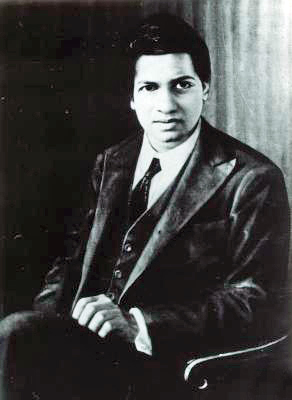
December 22 is the 125th anniversary of the birth of Srinivasa Ramanujan, an Indian mathematician renowned for somehow intuiting extraordinary numerical patterns and connections without the use of proofs or modern mathematical tools. A devout Hindu, Ramanujan said that his findings were divine, revealed to him in dreams by the goddess Namagiri.

“I wanted to do something special, in the spirit of Ramanujan, to mark the anniversary,” says Emory mathematician Ken Ono. “It’s fascinating to me to explore his writings and imagine how his brain may have worked. It’s like being a mathematical anthropologist.”

Ono, a number theorist whose work has previously uncovered hidden meanings in the notebooks of Ramanujan, set to work on the 125th-anniversary project with two colleagues and former students: Amanda Folsom, from Yale, and Rob Rhoades, from Stanford.

Srinivasa Ramanujan
The result is a formula for mock modular forms that may prove useful to physicists who study black holes. The work, which Ono recently presented at the Ramanujan 125 conference at the University of Florida, also solves one of the greatest puzzles left behind by the enigmatic Indian genius.

While on his death-bed in 1920, Ramanujan wrote a letter to his mentor, English mathematician G. H. Hardy. The letter described several new functions that behaved differently from known theta functions, or modular forms, and yet closely mimicked them. Ramanujan conjectured that his mock modular forms corresponded to the ordinary modular forms earlier identified by Carl Jacobi, and that both would wind up with similar outputs for roots of 1.

No one at the time understood what Ramanujan was talking about. “It wasn’t until 2002, through the work of Sander Zwegers, that we had a description of the functions that Ramanujan was writing about in 1920,” Ono says.

Building on that description, Ono and his colleagues went a step further. They drew on modern mathematical tools that had not been developed before Ramanujan’s death to prove that a mock modular form could be computed just as Ramanujan predicted. They found that while the outputs of a mock modular form shoot off into enormous numbers, the corresponding ordinary modular form expands at close to the same rate. So when you add up the two outputs or, in some cases, subtract them from one another, the result is a relatively small number, such as four, in the simplest case.

“We proved that Ramanujan was right,” Ono says. “We found the formula explaining one of the visions that he believed came from his goddess.”

“No one was talking about black holes back in the 1920s when Ramanujan first came up with mock modular forms, and yet, his work may unlock secrets about them,” Ono says.

Ono uses a “magic coin” analogy to illustrate the complexity of Ramanujan’s vision. Imagine that Jacobi, who discovered the original modular forms, and Ramanujan are contemporaries and go shopping together. They each spend a coin in the same shop. Each of their coins goes on a different journey, traveling through different hands, shops and cities.

“For months, the paths of the two coins look chaotic, like they aren’t doing anything in unison,” Ono says. “But eventually Ramanujan’s coin starts mocking, or trailing, Jacobi’s coin. After a year, the two coins end up very near one another: In the same town, in the same shop, in the same cash register, about four inches apart.”

Ramanujan experienced such extraordinary insights in an innocent way, simply appreciating the beauty of the math, without seeking practical applications for them.

“No one was talking about black holes back in the 1920s when Ramanujan first came up with mock modular forms, and yet, his work may unlock secrets about them,” Ono says.

Expansion of modular forms is one of the fundamental tools for computing the entropy of a modular black hole. Some black holes, however, are not modular, but the new formula based on Ramanujan’s vision may allow physicists to compute their entropy as though they were.

Watch the trailer to a forthcoming film about the life of Ramanujan:

After coming up with the formula for computing a mock modular form, Ono wanted to put some icing on the cake for the 125th-anniversary celebration. He and Emory graduate students Michael Griffin and Larry Rolen revisited the paragraph in Ramanujan’s last letter that gave a vague description for how he arrived at the functions. That one paragraph has inspired hundreds of papers by mathematicians, who have pondered its hidden meaning for eight decades.

“So much of what Ramanujan offers comes from mysterious words and strange formulas that seem to defy mathematical sense,” Ono says. “Although we had a definition from 2002 for Ramanujan’s functions, it was still unclear how it related to Ramanujan’s awkward and imprecise definition.”

Ono and his students finally saw the meaning behind the puzzling paragraph, and a way to link it to the modern definition. “We developed a theorem that shows that the bizarre methodology he used to construct his examples is correct,” Ono says. “For the first time, we can prove that the exotic functions that Ramanujan conjured in his death-bed letter behave exactly as he said they would, in every case.”

A highlight of working on a film about Ramanujan's life was getting to browse through some of the Indian master's original notebooks, says Ono, above right.

Although Ramanujan received little formal training in math, and died at the age of 32, he made major contributions to number theory and many other areas of math.

In the fall, Ono traveled to Ramanujan’s home in Madras, and to other significant sites in the Indian mathematician’s life, to participate in a docu-drama. Ono acted as a math consultant, and also has a speaking part in the film about Ramanujan, directed by Nandan Kudhyadi and set to premiere next year.

“I got to hold some of Ramanujan’s original notebooks, and it felt like I was talking to him,” Ono says. “The pages were yellow and falling apart, but they are filled with formulas and class invariants, amazing visions that are hard to describe, and no indication of how he came up with them.”

Ono will spend much of December in India, taking overnight trains to Mysore, Bangalore, Chennai and New Dehli, as part of a group of distinguished mathematicians giving talks about Ramanujan in the lead-up to the anniversary date.

“Ramanujan is a hero in India so it’s kind of like a math rock tour,” Ono says, adding, “I’m his biggest fan. My professional life is inescapably intertwined with Ramanujan. Many of the mathematical objects that I think about so profoundly were anticipated by him. I’m so glad that he existed.”

Related:
New theories reveal the nature of numbers
A surprise dimension to adding and counting
How a hike in the woods led to a math 'Eurkea!'

Image credits: Hindu temple by iStockphoto.com; Ramanujan photo via Oberwolfach Photo Collection/Konrad Jacobs; black hole simulation by NASA, M. Weiss (Chandra X-Ray Center); bottom photo courtesy of Ken Ono.

Monday, December 10, 2012

Aladdin to Lincoln: How stories shape a life


The tales that we read, and the tales that we spin about ourselves, play a role in helping us realize our full potential, says Jordan Greenwald, who gave a TEDxEmory talk last spring (see above video) as an Emory senior, majoring in psychology.

Greenwald counts stories of both the fictional Aladdin, and the real-life Abraham Lincoln as strong influences in shaping his own life.

“Stories give us an emotional education, “ Greenwald says. “If we don’t address this inner world of dreams, desires, anxieties, we risk meandering, which really means forfeiting who we could become.” 

Related:
Prometheus: Seeding wonder and science
Stories your parents should have told you

Thursday, June 7, 2012

Prometheus: Seeding wonder and science

Michael Fassbinder plays a robot attendant on the spaceship Prometheus.

In Greek mythology, Prometheus paid a heavy price for stealing fire from Zeus and giving it to mortals. The story is a powerful cautionary tale about the rewards and risks of striving for scientific knowledge.

Ridley Scott’s “Prometheus,” opening June 8, ratchets up the theme by adding space travel and all the special effects of Hollywood. The movie’s premise, that extraterrestrial engineers seeded Earth with their molecular basis, is a fitting story for our times, says David Lynn, chair of chemistry at Emory.

Lynn, an expert in chemical evolution, is studying how life evolved from the “warm pond” of early Earth, some 3.5 billion years ago. “All the life that we understand now depends on liquid water,” Lynn says. “Ironically enough, the liquid water on earth probably came from extrasolar sources and accumulated on earth after the planet was forming. So this notion of having our planet seeded by water and by other nutrients or even building blocks of life is something that we’ve known about for a long time.”


In addition to studying how life evolved on Earth, Lynn heads a scientific team that is developing parameters for NASA to search for extraterrestrial life. Powerful telescopes have revealed an extraordinary number of exoplanets in our galaxy. But where should we start looking for life beyond Earth, and how would we know it if we saw it?

The crew in the movie “Prometheus” is also seeking extraterrestrial life, but they have the benefit of a star map discovered among the ruins of an ancient Earth civilization.

Our species has a history of imaging alien life forms, Lynn says, pieced together from dreams and whatever data is available at the time.

These stories often have value beyond entertainment. “They can be motivators for our imaginations, and for more science to try to understand our place in this universe that we inhabit,” Lynn says. "That's what makes the stories we have so important."

Related:
Chemists boldly go in search of 'little green molecules'
Fueling the dream of travel to the stars
Peptides may hold missing link to life

Friday, March 2, 2012

Fueling the dream of travel to the stars

Interstellar travel is a fantasy of many children, and believe it or not, the ambition of some scientists. Photo from 2008 Maker Faire by Jim Merithew/Wired.com.

Human space technology may be limited, but human dreams are not. Emory physicist Sidney Perkowitz was among the ex-astronauts, engineers, artists, theologians, students and science-fiction writers who celebrated that paradox during the 100 Year Starship Study (100YSS) conference last fall in Orlando.

Think robots in space, nuclear fission, solar-powered sails. These are just a few of the ideas being bandied about for making interstellar travel a reality.

In a report on the conference for a recent issue of Physics World, Perkowitz describes what it was like to be immersed in “humanity’s adventurous, stubborn, mad and glorious aspiration to reach the stars.” Following is an eScienceCommons interview, about the dreamers and doers pushing at our horizons.

eScienceCommons: Who is behind the 100YSS and the conference?

Sidney Perkowitz: It was organized by the Defense Advanced Research Projects Agency (DARPA) of the U.S. Department of Defense. DARPA is famous for being willing to sponsor off-the-wall ideas, because you never know where basic research will take you. Supposedly, they’ve looked into things like telepathy and telekinesis, pure science-fiction stuff. But DARPA points out that research into space travel has brought advancements in technologies with civilian applications, like robotics, batteries and new materials. DARPA doesn’t necessarily believe that someone will build a starship, but the effort to do so could provide some useful spin-offs.

The Space Shuttle Endeavour'srobotic arm hovers over Earth's horizon, before a starburst from the Sun. Photo by NASA.

eSC: What kind of people attended the starship conference?

Perkowitz: All kinds. Mae Jemison was there. She is a former NASA astronaut and the first black woman to travel in space. Among the many things she’s involved with is a program encouraging young people to go into science.

I met another scientist, a Georgia Tech graduate interested in founding a company to sweep up all the human-made space debris floating around the Earth. And I heard a talk by an Iranian woman who had come up with the money to become one of the few civilians to go into space. She said that once you’ve done that, you never think about Earth in the same way.

There were a couple of visual artists there, who felt they would be inspired by hearing more about space travel, and a lot of science fiction writers. A theologian at the conference gave an interesting talk about space travel being a kind of spiritual expansion, like going beyond the roof of a cathedral. Another theologian made a complicated argument about the nature of evil and redemption, and how they might apply to life on other planets.

The ideas of some people at the conference were completely off the wall, but who knows? You should always have some visionaries around. Some of them will be wrong, but some of them will be right.

An artist's impression of how common planets are around the stars in the Milky Way. Art by European Southern Observatory/M. Kornmesser.

eSC: How realistic is it that we could ever reach even one of the closest stars to the sun, more than 4 light years away?

Perkowitz: I don’t think it’s going to happen soon. The distances are so great, I’m not sure that technology will ever match them. But I believe that we should keep trying, just like we should keep trying to cure cancer. I think the dream of interstellar travel is important to the human race.

Unmanned space probes armed with telescopes and other instruments have allowed us to learn more about the solar system during the last 20 years than we have during the previous 2,000 years. The discovery of exo-planets has changed our whole conception of the universe. We used to think there were nine planets, then eight because they demoted Pluto. The latest findings suggest that there are actually more planets in our galaxy than stars. That’s phenomenal, and it opens up the possibility of extraterrestrial life by a factor of millions.

Related:
Fantastic light: From science fiction to fact
Is Iron Man suited for reality?

Monday, May 2, 2011

Grandma was right: Infants wake up taller


Dreams of reaching great heights: A new study shows that daily growth and sleep patterns are inextricably linked. Credits, above and below: iStockphoto.com.

By Robin Tricoles

Science is finally confirming what grandma knew all along: Infants wake up taller right after they sleep.

Findings from the first study of its kind measuring the link between daily growth and sleep show the two are inextricably linked. Specifically, growth spurts are tied to an increase in total daily hours of sleep as well as an increase in the number of daily sleep bouts, the time from the onset of sleep until awakening.

“Little is known about the biology of growth spurts,” says Emory anthropologist Michelle Lampl, lead author of the study. “Our data open the window to further scientific study of the mechanisms and pathways that underlie saltatory growth.”

Practically speaking, however, the study helps parents understand that irregular sleep behavior is a normal part of growth and development.

“Sleep irregularities can be distressing to parents,” says Lampl, associate director of Emory’s Predictive Health Institute. “However, these findings give babies a voice that helps parents understand them, and show that seemingly erratic sleep behavior is a normal part of development. Babies really aren’t trying to be difficult.”

The study, published today by SLEEP, was co-authored by pharmacologist Michael Johnson of the University of Virginia.

The researchers also found that longer sleep bouts in both girls and boys predicted an increase in weight and body-fat composition tied to an increase in length. In other words, not only does sleep predict a growth spurt in length, but it also predicts an increase in weight and abdominal fat, implying an anabolic process—growth.

What’s more, the study showed differences in sleep patterns related to growth depending on the sex of the baby. “Growth spurts were associated with increased sleep bout duration in boys compared with girls and increased number of sleep bouts in girls compared with boys,” Lampl says.

In general, boys in the study exhibited more sleep bouts and shorter sleep bouts than girls. But neither the sex of the infant nor breastfeeding had significant effects on total daily sleep time. However, breastfeeding as opposed to formula feeding was associated with more and shorter sleep bouts.

Unlike previous studies, this study did not rely on parental recall of infant sleep patterns and growth. Instead, data on 23 infants were recorded in real time over a four- to 17-month span. Mothers kept daily diaries detailing sleep onset and awakening and noted whether babies were breastfeeding, formula feeding, or both and whether their infant showed signs of illness, such as vomiting, diarrhea, fever or rash.

Related:
That diaper's full of data
How childhood makes us who we are
How babies do math

Monday, August 24, 2009

Test your behavioral IQ

Are the following statements true or false:
1. Inkblots reveal a great deal about someone's personality.
2. Studies show a tendency for people to marry someone whose name begins with the same letter as their own.

3. Researchers have demonstrated that dreams possess symbolic meaning.

4. The defining feature of dyslexia is reversing letters.

5. Men and women communicate in completely different ways.


What do you think?
Graphic: "50 Great Myths of Popular Psychology"

Actually, the only true statement is No. 2. The others are either completely false, or "gross exaggerations of a kernel of truth," says Emory psychologist Scott Lilienfeld, who co-authored the new book "50 Great Myths of Popular Psychology: Shattering Widespread Misconceptions about Human Behavior."

"Bursting bubbles can be painful," says Lilienfeld. "But we hope that puncturing some of these myths can lead people to better life decisions, and a more realistic appraisal of themselves."

Folk wisdom and so-called commonsense too often trump science in our society, Lilienfeld says. "There is this idea that we can understand the world, including our own minds, by gut instinct – that if something seems intuitively right, it must be right. To embrace a scientific approach is to be humble, but that's not a popular message in American society, which rewards certainty."

Related story:
Is hypnosis just hocus-pocus?
The anger myth: Read this before blowing up