Showing posts with label Humor/Fun. Show all posts

Friday, February 14, 2025

Celebrating Valentine's Day and science

Emory biophysicists Jennifer Rieser and Gordon Berman enjoy a hike in Aspen following a summer conference.

Jennifer Rieser, assistant professor of physics, and Gordon Berman, associate professor of biology, connected at Cornell University in 2006. They are fascinated by the biophysics of animal behaviors, tackling esoteric questions such as variations in how organisms move. 

“We both noticed each other,” Berman recalls of their first meeting. Berman was already working on his PhD, studying the biodynamics of insect flight, when Rieser attended a recruitment weekend for graduate students. 

“I reached out to him afterwards to learn more about what it’s like at Cornell,” Rieser says. 

Berman didn’t discourage her. She was enrolled that fall, and, by Christmas, Berman informed his mother he had a girlfriend. 

They married in 2010. Their eventual move to Atlanta was a homecoming for Rieser, who grew up in nearby Lawrenceville, while Berman is from Michigan. 

During the COVID-19 lockdown they shared a Midtown loft, teaching online on opposite sides of the space, sometimes simultaneously. “And we didn’t get tired of each other,” Berman says. “We survived that test.” 

They now live just a few blocks from campus with daughter, Naomi, who is two-and-a-half, and dogs Escher and Kona. 

Berman focuses more on theoretical and computational methods, while Rieser takes an experimental approach to the locomotion of everything from snakes to ants. They often run their research by one another to get feedback from their complementary strengths. 

They manage to combine work and play, traveling together following conferences or summer teaching gigs that took them to Brazil, Italy and Germany. And they enjoy cooking and eating nice meals. 

“I tend to bake things,” Rieser says. 

“She’s more a creature of precision,” Berman explains. “Her signature dish is a chocolate babka, a very decadent bread.” 

"He’s more of an improvisational chef,” Rieser says. 

“Give me a cabinet of ingredients and a couple of adjectives,” Berman says, “and I can make you a bespoke, likely unrepeatable cocktail.”

Thursday, March 28, 2024

'Jeopardy!' contestant creates buzz with psychological study of trivia experts

'Jeopardy!' contestant and Emory psychologist Monica Thieu, shown with host Ken Jennings, during the 2024 "Jeopardy!" Invitational Tournament.

Monica Thieu is a four-time "Jeopardy!" contestant and a postdoctoral fellow in Emory's Department of Psychology. Psychonomic Bulletin & Review recently published her finding that two memory systems — one for facts and another for personal experiences  are more entwined in the minds of top trivia experts compared to others. 

"In trivia experts, it appears that these two systems are talking to each other in unique ways," Thieu says. "Our findings for this special population may help us better understand how memory works in normative populations."

Thieu says her personal experience in trivia competitions helped in the design of the study. 

"It's trick to make sure that lab experiments are both rigorous and reflect lived experience," Thieu says. "I know the world of trivia experts well."


Related:


Tuesday, September 13, 2022

Science and creativity combine to imagine a city where everyone thrives

"I never imagined that I'd be co-teaching with a comedian," says Emory biologist Micaela Martinez, "but it's awesome working with David." Photo by Kay Hinton.

A scientist and a comedian walk into a classroom. They start a discussion about how art can influence social justice. 

You’ll have to wait for the punchlines. Emory first-year students will create them as part of a new fall seminar “Human Flourishing: Imagine a Just City.” 

“Humans cannot flourish without true justice,” says Micaela Martinez, Emory assistant professor of biology, who developed the class. “We have so many huge societal problems that need creativity, imagination, hope and optimism to solve.” 

The class is among the new First-Year Flourishing Seminars, aimed at deepening what students know but also who they aspire to be. It is also part of the Emory Arts and Social Justice Fellows program, which pairs Emory faculty with Atlanta artists to explore how creative thinking and artistic expression can inspire change. 

Martinez is co-teaching with Arts and Social Justice Fellow David Perdue, a comedian. 

“You can’t save the world with jokes,” Perdue says. “But humor can be a good way to raise awareness of what’s going on. It’s a first step.” 

Read the whole story.

Friday, September 9, 2022

Physicist seeks ultimate formula for fun

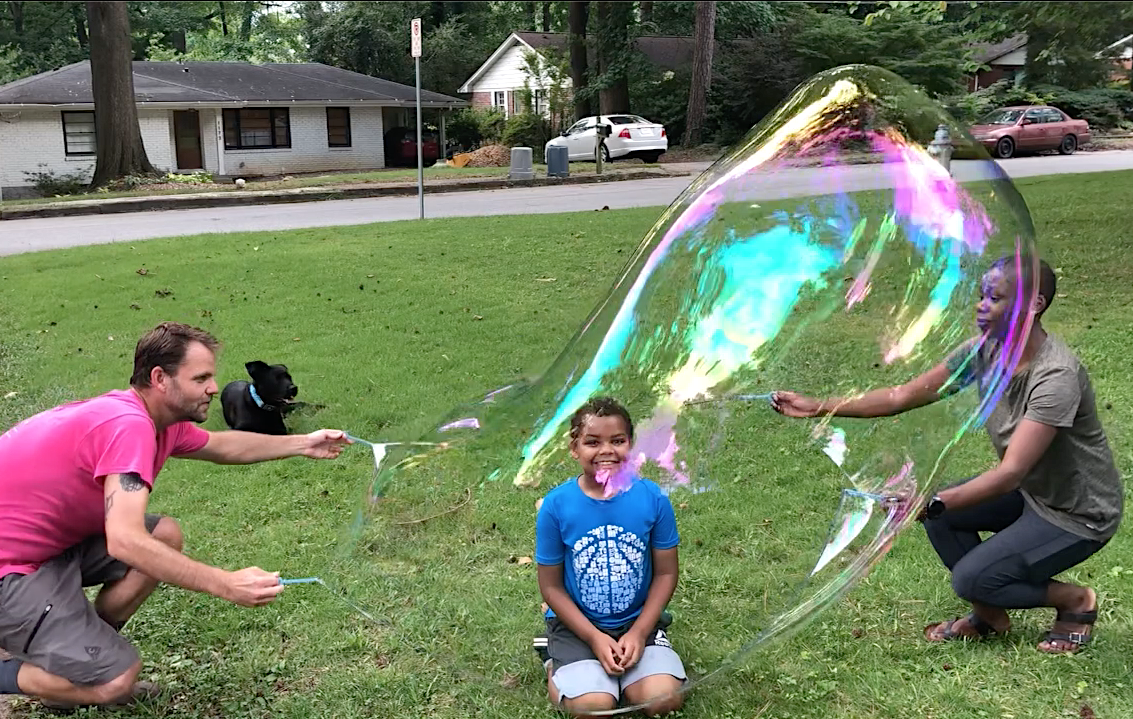
Justin and Afeira Burton encase their son Jonah in a giant bubble while their dog Boba Fetch looks on.

By day, Justin Burton is an Emory associate professor of physics, conducing high-level research on fluid dynamics and granular materials. Evenings and weekends, however, he turns into a comic-book version of a scientist. Not a mad scientist, tough. More like a glad scientist.

Read more about his alter ego, Dr. Bubbles, here.

Related:

The physics of giant bubbles

Tuesday, February 4, 2020

Physics secrets of giant bubbles


A study inspired by street performers making gigantic soap bubbles led to a discovery in fluid mechanics: Mixing different molecular sizes of polymers within a solution increases the ability of a thin film to stretch without breaking. The journal Physical Review Fluids published the results of the study by physicists at Emory University.

The findings could potentially lead to improving processes such as the flow of oils through industrial pipes and the clearance of polluting foams in streams and rivers. The results also hold implications for backyard bubble-blowing enthusiasts.

“This study definitely puts the fun into fundamental science,” says Justin Burton, associate professor of physics at Emory University and senior author of the paper.

Click here to read the full story, including Burton's favorite recipe to make your own giant soap bubbles.

Emory physicist Justin Burton, left, experiments with giant soap bubbles on the Quad with Stephen Frazier, who received his masters in physics from Emory and is first author of the discovery. 

Related:
How lifeless particles can become 'life-like' by switching behaviors
The physics of a glacial 'slushy'
Physicists crack another piece of the glass puzzle

Thursday, October 24, 2019

The psychology of thrills and chills

Monsters do not thrill psychologist Ken Carter, shown at Netherworld in Stone Mountain. Photo by Kay Hinton.

Psychologist Kenneth Carter is not a fan of Halloween haunted houses. But he has written a book about people who thrive on activities like entering dark passageways, sensing that something unknown and terrifying awaits around the next corner.

“I don’t enjoy having things come out of nowhere,” says Carter, whose long-anticipated book “Buzz! Inside the Minds of Thrill-Seekers, Daredevils and Adrenaline Junkies” comes out October 31. “Buzz!” both educates and entertains with insights from real-life adventurers, such as a scaler of skyscrapers, known as “Spider Man,” who enjoys hanging from great heights suspended by only his fingers.

Cambridge University Press is publishing the book, the culmination of years of research into high sensation-seeking people by Carter, a professor at Oxford College of Emory University and a self-described low sensation-seeking personality type.

“I love Halloween because it brings both extremes together, there’s something for everyone,” Carter says. “For me, it’s candy corn. That’s my second favorite candy, after Smarties. I enjoy the sweet, silly side of Halloween — not the dark, scary side. I don’t want to get lost in a corn maze or watch ‘The Children of the Corn.’”

Read the full story here.

Monday, February 11, 2019

Atlanta Science Festival to launch at Emory with the power of WOW!

Wow in the World host Mindy Thomas, center, will kick off the Atlanta Science Festival with the help of musical duo The Pop Ups (Jacob Stein, left, and Jason Rabinowitz).

By Carol Clark

Watch for serious fun to spring up all around town as part of the 2019 Atlanta Science Festival, March 9 to March 23. The festival begins with a Wow in the World Pop Up Party on Saturday, March 9 from 11 am to noon on the Emory University campus. Mindy Thomas, a host of the popular NPR science-themed podcast Wow in the World, will engage curious kids and their grown-ups in games and skits with mad musical accompaniment by the Pop Ups — creators of the children’s music album Giants of Science.

A "Wow in the World" launch
“Wow in the World is an excellent program for kids and we really wanted to bring the energy of its team to Atlanta,” says Meisa Salaita, co-director of the Atlanta Science Festival. “They tie new and relevant research into interesting topics for kids, everything from ants that explode to seaweed that might boost your brain power. Kids are our future and getting them excited about science is so important.”

Kids will enjoy skits and games inspired by topics from the podcast like “Contagion Alert: The Science of Trying Not to Laugh” and “It SNOT What You Think.” Tickets are required for the launch event, set at Emory’s Glenn Memorial United Methodist Church, and it is expected to sell out.

The Atlanta Science Festival, or ASF, will feature more than 100 events throughout the metro area hosted by school districts, universities, museums, businesses and civic and community groups. Delta Air Lines is the presenting sponsor for 2019.

This year, Emory scientists will lead a walk with Mesozoic dinosaurs, discuss how neuro-engineering is blurring the lines between mind and machine and describe the physics of how babies learn to talk. Click here to see a full list of events connected to Emory.

Hundreds of visitors are expected on the Emory campus on Friday, March 22 for the perennial festival favorites, "Chemistry Carnival" and "Physics Live!"

“Science on Stage: The Forgotten Organ,” stars the bacteria, fungi and viruses within the human microbiome that shapes every one of us from birth. The Emory Center for the Study of Human Health teamed up with Theater at Emory to have playwrights quickly produce short plays about the microbiome. The playwrights drew their inspiration from a New York Times bestselling book by science writer Ed Yong, “I Contain Multitudes: The Microbes Within Us and a Grander View of Life.”

Yong will join the playwrights for readings of their works and a panel discussion of this unique collaboration between art and science. This event is set for Wednesday, March 20, at 6:30 pm at the Carter Presidential Library and Museum.

The Emory event “Become an Archaeologist” returns on Thursday, March 21 from 6 to 8 pm. This year the faculty and students involved are taking their bones off campus, to Brownwood Park in East Atlanta Village. The Emory experts will teach community members how to extract DNA and put pieces of ancient objects back together like a puzzle. “It’s a great example of the festival taking events that we know are popular and setting them in other parts of the city so that we can continue to reach new audiences and connect in different ways,” Salaita says. “Our goal is to keep broadening access to our programming.”

Two perennial festival favorites — Chemistry Carnival and Physics Live! — return this year to the Emory campus on Friday, March 22 from 3:30 to 7 pm. Emory science faculty and students will explain their research, give lab tours, and entertain with games like Peptide Jenga, a chance to play with giant soap bubbles and tastings of liquid nitrogen ice cream. Hundreds of visitors are expected to turn out for the events, held in the Mathematics and Science Center and Atwood Chemistry Center.

Oxford hosts "Ada and the Engine"
A highlight on Emory’s Oxford campus will be performances of the play “Ada and the Engine,” portraying the groundbreaking career of Ada Lovelace — a mathematician, poet and the first computer programmer. The play was written by Lauren Gunderson, an acclaimed playwright who graduated from Emory in 2004. During the festival, the play will be performed Friday and Saturday, March 21 and 22, at 7:30 pm. Performances will be followed by talks on the themes of women working in a field dominated by men, and a chance to walk through a special interactive exhibition, "Reviving Ada," curated by Oxford students to celebrate women's contributions to STEM fields from throughout history.

The festival culminates on Saturday, March 23 with the Exploration Expo at Piedmont Park — a day-long, free carnival of science with hundreds of hands-on activities. More than a dozen booths will feature Emory faculty and students, who will engage crowds in activities with names like “Air Pollution Particle Toss,” “Opening a Can of Worms: Exploring Biomaterials and Nanotechnology with Alginate Gummy Worms,” “Smell the World,” and “Can You Guess What Your Brain is Thinking?”

Founded in 2014 by Emory University, Georgia Tech and the Metro Atlanta Chamber, the ASF celebration of local science, technology, engineering and math has brought programming to more than 200,000 people in the metro region, reaching a diverse audience of a wide variety of ages. 

Special funding from sponsors such as Delta, the Arthur M. Blank Family Foundation and others is helping ASF soar to new heights and extend some of its programming and events year-round. A chief science officer program charges student representatives from middle schools and high school to foster science communities at their schools.

“These chief science officers, who are elected by their student bodies, receive leadership training, meet with state legislators and learn about the role of science and policy,” Salaita says. “We launched the program this year with 22 students and we plan to grow exponentially over the next three years to 200 students.”

Another program piloted this past year by the ASF is a science communication training fellowship for graduate students and post-doctoral fellows. “We’ve started with eight students who met monthly to learn about narrative in science communication, data visualization and other communication techniques,” Salaita says. “They will use their new skills to create events for the science festival and give informal talks to the general public.”

Another new component of the ASF is a year-round calendar of STEM-themed activities. “We want people to stay connected to science,” Salaita explains. “Our new events calendar is a guide for family friendly activities in the metro Atlanta area when the festival’s not happening.”

Wednesday, May 16, 2018

Chemistry students sing their studies, hoping for a good reaction


By Carol Clark

On the last day of the spring semester, during Bill Wuest’s “Principles of Reactivity” course, loud noises rattle the Atwood Chemistry Center’s Atomic Classroom. It isn’t explosions — it’s pop music mixed with bursts of laughter.

“This bond’s alright!” a group of Emory first-year students belts out on a YouTube video playing on screens before the class. Backed by the music of “Oh, What a Night,” they dance before a periodic table, write on a white board and mix chemicals in a lab while singing lyrics they wrote themselves: “Now I use a base to synthesize. It can readily be hydrolyzed. Mechanisms, what a sight!”

In just under four minutes, the students sing key lessons they learned over the semester about carbonyl mechanisms.

“It’s basically describing how reactions go,” explains Rebecca Henderson, one of the performers. “A reaction is not normally just putting two chemicals together and — BOOM — a product comes out. There’s a lot of different steps involved and we wanted to describe some of them, and why a reaction goes down one pathway and not another.”

Henderson created the video with classmates Carson Brooks, Lauren Cohen, Justine Griego and Alex Kim. They all played themselves in the video — except for Kim, who used powder to create a white patch in his hair and portray the professor.

“I love it when they mock me, they get extra points for that,” says Wuest, who has a natural, white streak of hair running through the center of his close-cropped dark hair.

Wuest, who joined Emory in the fall of 2017 as a Georgia Research Alliance Distinguished Investigator, directs an organic chemistry lab along with teaching undergraduates. He started having students make music parody videos while he was at Temple University.

“A lot of people think that chemistry is dry and boring but there’s a lot of creativity involved in it and that’s often overlooked in classrooms,” Wuest says.

The videos fit in well with Emory’s curriculum. Last fall, Emory became one of the first major research universities to completely overhaul how chemistry is taught, from introductory courses to capstone seminars. The new program, called Chemistry Unbound, moves away from teaching a narrow slice of chemistry every year to jumping into a big-picture understanding of chemistry’s central role across the sciences.


The video assignment helps with those big-picture concepts, Wuest says. Students form groups of up to six to make a two-to-four-minute educational video about some aspect of what they’ve learned in class. The video can either take the form of a musical parody of a well-known song or — for the less adventurous — a more straightforward lesson in the style of the Khan Academy website.

While Wuest is not the first to have chemistry students make videos, he is one of the few to actually measure their effect. With the help of his wife, Liesl Wuest, an educational analyst who also works at Emory, he has compared learning outcomes — in the form of exam performance before and after the videos — and found a strong correlation to improved scores.

His Temple students received extra credit, but not a grade, for making videos. Out of 130 students, 25 percent of them opted to do the videos. The average score for the class on an exam before the video project and an exam following the video project found that those who made videos had an average of 50 percent more improvement in their scores compared to those who opted out.

“Making the videos forces students to think about the material in new ways,” Wuest says. “It also makes the material more memorable to help it stick with them long term.”

Wuest refined the criteria for the video project and turned it into a graded requirement for his Emory classes. The top videos, based on accuracy and execution, will be housed on the Canvas learning management system so that future students can use them for inspiration and study aids.


“I was really impressed with the level of the videos this semester,” Wuest says. “They showcase the quality and the diversity of the students at Emory.”

Wuest plans to continue measuring the effect of the videos on learning. Many of the students, meanwhile, have given the video assignment a big thumb’s up.

“Not only do you learn the material, but it’s a fun experience,” says Dennis Jang, a first-year student.

Jang helped make a video called “I’ll Make a Chemist Out of You,” set to the song “I’ll Make a Man Out of You” from the Disney movie “Mulan.” The other first year students in his group included Muhammad Dhanani, Alex Fukunaga, Gaby Garcia and Jessie Kwong.

“The hardest part of this project was balancing the content and the comedy,” Jang says. “We presented some broad aspects of what we learned in class and some more specific aspects. And then we added humor to keep the audience watching.”

The formula worked. An informal vote following the screening of the videos in class, based on laughter and applause, showed “I’ll Make a Chemist Out of You” was the clear audience favorite.

“As we were watching all of the videos together we were laughing and just really enjoying being together,” Henderson says. “It was the final wrap-up of a great semester. Bill really knows how to make a true community out of a classroom.”

You can watch more of the videos by clicking here. 


Related:
Chemistry synthesizes radical overhaul of undergraduate curriculum

Wednesday, March 28, 2018

The Peeps experiments: A seasonal celebration of science

Why experiment on Peeps? "Because they're there!" says Emory chemist Douglas Mulford. Photo by Carol Clark.

It’s that time of year again when Peepus Marshmalleous, commonly known as Peeps, pop up everywhere — even in an Emory University chemistry lab.

Emory's groundbreaking Peeps research began in 1999 when researchers Gary Falcon and James Zimming investigated the effects of smoking and alcohol on Peeps health and performed the medical miracle of separating quintuplet Peep siblings, conjoined at birth. You can read more here: peepresearch

Douglas Mulford, senior lecturer and director of undergraduate studies for the Department of Chemistry, continues the tradition by treating students every spring to a Peeps show. “Basically, it’s 45-minutes of every chemical thing that you can do to a Peeps,” Mulford explains. “It’s amazing what they can survive.” 

Watch a brief video summarizing the show, below. And check out Emory’s new Instagram account, Science Seen, for more quick, behind-the-scenes looks at science at Emory.

Thursday, February 22, 2018

Frankenstein and robots rise up for Atlanta Science Festival

Hair-raising, spine-tingling fun: A young visitor to the Emory campus during last year's Atlanta Science Festival experiences the thrill of static electricity.

By Carol Clark

From the lumbering, 200-year-old Frankenstein to sleek, modern-day robots, this year’s Atlanta Science Festival — set for March 9 to 24 — highlights creations that spark wonder and fun, giving glimpses of the past and the future.

The five-year-old festival expanded to more than two weeks, encompassing 120 events sponsored by 90 different partners at 70 venues across metro Atlanta, including many on the Emory campus. The festival culminates with a day-long “Exploration Expo” on Saturday, March 24, set in Piedmont Park.

“Rise Up, Robots!” kicks off the festival on the evening of Friday, March 9 at the Ferst Center, when three robots and their inventors will take the stage.

“We thought about how we could possibly top last year’s featured speaker, astronaut Mark Kelly — someone so inspirational to children and adults all over the planet,” says Meisa Salaita, co-director of the Atlanta Science Festival. “We finally realized that no human could match him, and we would have to resort to artificial intelligence.”

Heather Knight, professor of robotics at Oregon State University, will demonstrate the interactive quips of “Data,” the world’s first robotic comedian. Georgia Tech’s Gil Weinberg will jam with “Shimon,” a marimba playing robotic musician. And Stewart Coulter, from DEKA Research and Development, will show how a bionic arm named LUKE (Life Under Kinetic Evolution) changed an amputee’s life.

Tickets are required for the event, which starts at 7 pm. Door open early with an Interactive Robotic Petting Zoo, starting at 6 pm.

Frankenstein rises up on the Emory campus on Thursday, March 22. Three Atlanta playwrights will reanimate Mary Shelley’s creation, which turns 200 this year, in the context of scientific research ongoing at Emory. Following the short plays join ethicists, scientists and the playwrights to discuss the work over refreshments. The event, titled “Frankenstein Goes Back to the Lab,” begins at 5:30 pm in Emory’s Science Commons.

On Friday, March 23, from 3:30 to 7 pm, Emory will host “Chemistry Carnival,” where visitors can join scientists in carnival games like Peptide Jenga and Bacterial Telepathy, in the Atwood Chemistry Center. On the same day and time, the ever-popular “Physics Live!” will again feature giant soap bubbles and liquid nitrogen ice cream, among other treats in the Math and Science Center.

A new Emory event this year, “Science.Art.Wonder,” will run concurrently with the chemistry and physics events, on the Emory Quadrangle and in nearby buildings, including White Hall and the Atwood Chemistry Center. For the past year, the program has paired local artists and scientists to explore ideas of research through the visual arts. You can stroll through an exhibit of the resulting artwork and meet some of the artists and scientists involved in the project.

Adult fare is featured on Monday, March 19, including “The Science of ‘Motherese,’” an overview of early vocal development in infants at the Marcus Autism Center, and “CDC in the Scene,” which features CDC scientists sorting fact from fiction surrounding movies like “Outbreak,” in the Mathematics and Science Center.

On Tuesday, March 20, “Become an Archeologist” lets you in on secrets revealed by ancient skeletons and artifacts, while “Mock Climate Change Negotiation” turns you into an international policymaker for a day.

During “Unveiling the Internet,” on Wednesday, March 21, Emory computer scientists will give interactive lessons on everything from the workings of YouTube to Snapchat.

“STEM Gems: Giving Girls Role Models in STEM Careers,” on Saturday, March 10, is an interactive discussion where panelists offer advice and guidance specific to girls and young women intrigued by science, technology, engineering and math. “Women and Minorities in STEM: Surprises, Setbacks and Successes,” set for the evening of Thursday, March 22 at the Oxford campus, is a panel discussion with voices from a diverse set of scientific fields who will share their stories and take questions.

Click here for more details of Emory campus events, and events throughout the city featuring members of the Emory community.

Among the dozen Emory booths at “Exploration Expo” will be chemistry students running their non-Newtonian fluid dance pit. The Center for the Study of Human Health will explore the human gut microbiome in a booth called “Your Hundred Trillion Best Friends.” And the “Science.Art.Wonder” team will display art from the program and invite you to help create a mural.

The Atlanta Science Festival was founded by Emory, Georgia Tech and the Metro Atlanta Chamber and is a collaboration among diverse community partners and sponsors.

Thursday, April 13, 2017

The Peeps experiments: Science that never goes stale


It’s that time of year again: The sugary, squishy, neon-bright baby chicks and bunnies known as Peeps have reappeared and people are inexplicably eating them. Vox wrote a roundup of some of the best cultural phenomena concerning Peeps over the years. It included an excerpt from a classic Emory Report story from 1999, describing how Emory researchers Gary Falcon and James Zimring “performed perhaps the most exhaustive Peeps testing in human history," exploring the candies’ durability in the face of a variety of substances:

“To test Peep solubility, they began with simple tap water, then moved on to boiling water, then to acetone, sulfuric acid and sodium hydroxide, but were left dumbfounded by Peeps' apparent invulnerability to each.

“Then they tried Phenol, a protein-dissolving solvent lethal to humans in amounts as small as a single gram. Peeps proved mortal to such a substance — well, almost. One hour after plunging an unfortunate Peep into its grisly demise, all that remained in the beaker was a pair of brown carnauba wax eyes floating in a purple Phenol soup.”

Emory’s groundbreaking Peeps research lives on at peepresearch.org, including details of an investigation of the effects of smoking and alcohol on Peeps health and the medical miracle of separating quintuplet Peep siblings, conjoined at birth.

Monday, March 6, 2017

Atlanta Science Festival celebrates 'frontiers of the unknown'

Participants in the Zombie Outbreak Game scoured Peavine Creek on the Emory campus in 2016 for clues to the cause of a mock epidemic. The popular game returns this year on Sunday, March 19.

By Carol Clark

Watch for an astronaut, zombies, a hovercraft and liquid nitrogen ice cream to pop up on the Emory campus during the Atlanta Science Festival, March 14 to March 25. Thousands of science enthusiasts, of all ages, are also expected to appear for the fourth annual event – which includes lab tours, talks, a planetarium show, movie screenings, science-themed dance and games and lots more interactive fun.

The festival blasts off at Emory this year with a talk by NASA astronaut Mark Kelly. Tickets are going fast in the countdown to the event, set for 7 pm on Tuesday, March 14 at Glenn Memorial United Methodist Church.

“Emory University is proud to be a founder and strong supporter of the Atlanta Science Festival, which is just one example of the university’s engagement with our city and region,” says Emory President Claire E. Sterk. “We welcome the local community to our campus for the launch of the 2017 festival and to hear astronaut Captain Mark Kelly. Captain Kelly is an inspiration to all of us who are seeking to push the frontiers of the unknown.”

Name the ASF mascot
The title of Kelly’s talk is “Endeavor to Succeed.” He will give an insider’s perspective on space travel and the year-long NASA experiment he is participating in with his twin brother, also an astronaut, on how space affects the human body.

The public is invited to enter a contest to name the festival's new astronaut mascot. Entries are due by Friday, March 10 at 5 pm, and the winner will receive four VIP tickets to Kelly's talk.

Following are highlights of other festival events set at Emory.

“STEM Gems: Giving Girls Role Models in STEM Careers,” brings together women leaders from business, academia, NASA and more for a panel discussion on Thursday, March 16. They will offer advice aimed at girls ages 10 and up, who are interested in careers involving science, technology engineering or math.

The “Zombie Outbreak Game” returns to campus this year, on Sunday, March 19, giving participants ages 12 and up a chance to investigate a mock zombie disease outbreak, using real-world tools employed by scientists at Emory and the Centers for Disease Control and Prevention. Actors from Out of Hand Theater will play the patients as participants don masks and gowns and follow a trail of clues through streams, woods and labs across campus.

A dance performance, “Creating a New Normal: Race, Identity, Health and Activism,” will explore the themes involved in working towards an AIDS free generation, on the afternoon of Monday, March 20. The performance will be followed by a conversation with scientists and public health researchers — hosted by the Emory Center for Ethics — on the past, present and future of viral diseases.

“Investigating Our Human Past,” the evening of Monday, March 20, will allow visitors to examine the Emory Anthropology Department’s cast collection of fossilized skulls of our ancestors. Scientists will be on hand to discuss recent advances in our understanding of how the human brain evolved.

The Mathematics and Computer Science Department will present “Unveiling the Internet,” geared for teens, on the evening of Thursday, March 23. Participants will meet in a computer lab to tinker with code and learn concepts like how Snapchat snaps move through space.
Physics Live! set for Friday, March 24

The ever-popular “Physics Live!” returns to the Emory Math and Science Center on Friday, March 24. Children will be entertained with giant soap bubbles, a hovercraft and liquid nitrogen ice cream, among other activities. This year, the physics fun will be joined by a “Chemistry Carnival” at the Atwood Science Center. Chemists will turn into midway barkers, awarding prizes to visitors who play games like Peptide Jenga and Bacterial Telepathy, based on ongoing research in Emory labs.

The Oxford Campus will host a “Critter Crawl” through Oxford Forest on Sunday, March 19, to learn about wildlife native to Georgia. And on Sunday, March 21, an event called “It’s About Time” will bring guests and local researchers together to share scientific and social concepts of time.

In addition to on-campus events, members of the Emory community will be featured in Atlanta Science Festival activities happening throughout metro Atlanta:

“Science and Spirituality” will explore the intersections of physics and faith, biology and belief. The panel of local scientists and theologians will include Arri Eisen, a biologist from Emory’s Center for Ethics. On Thursday, March 16 at First Christian Church of Decatur.

“The Science Behind Tremors, the Movie,” features Emory paleontologist Tony Martin who will provide a lively discussion about real animals that inspired giant fictional worms. On Sunday, March 19 at Fernbank Science Center.

A live show and podcast called “You’re the Expert” will bring together a panel of comedians and podcast host Chuck Bryant, who will good-naturedly grill Emory chemist Cora McBeth about her work. On Tuesday, March 21 at 7 Stages Theatre.

The Exploration Expo, the culminating event of the festival, will include scientists from Emory biology, chemistry, environmental sciences, the Emory Herbarium and the Emory Center for the Study of Human Health. They will be among the hosts of 100 booths offering science-themed activities for families during the culminating event of the festival, set for Centennial Park on Saturday, March 25.

Monday, February 6, 2017

Astronaut Mark Kelly to launch Atlanta Science Festival at Emory

Captain Mark Kelly, who led NASA missions into space, will lead off the action-packed schedule of this year's Atlanta Science Festival on Tuesday, March 14. His talk is entitled "Endeavor to Succeed." (NASA photo)

By Carol Clark

The 2017 Atlanta Science Festival blasts off on Tuesday, March 14 with a talk by Captain Mark Kelly – commander of Space Shuttle Endeavour’s final mission – at 7 pm in Emory’s Glenn Memorial Auditorium.

“We wanted to start off this year with someone who appeals to people of all ages and who epitomizes science in action,” says Meisa Salaita, co-executive director of the Atlanta Science Festival, which will continue through March 25 with events throughout the metro area. “Who better than an astronaut to show us how science can take us to new and exciting places?”

The title of Kelly’s talk is “Endeavour to Succeed.” Tickets for the event can be bought in advance on the Atlanta Science Festival’s web site for $12 ($8 for children 12 and under). They will also be available at the door the day of the event for $15.

Starting at 5:30 pm, during the countdown to Kelly’s talk, the public is invited to join toy rocket launching activities on the Glenn Memorial lawn, led by members of the Georgia Tech Ramblin’ Rocket Club and the Institute of Electronic and Electrical Engineers.

Kelly, who began his NASA career in 1996, commanded the Space Shuttle Discovery, as well as the Endeavour. He left the astronaut corps in the summer of 2011 to help his wife, former U.S. Congresswoman Gabrielle Giffords, recover from gunshot wounds she received in an assassination attempt on her life. The couple’s story captivated the nation, and they went on to found Americans for Responsible Solutions to advocate for gun control.

NASA is comparing biological data from the Earth-bound Kelly with his identical twin brother, Scott Kelly, who recently spent a year in space. The unique Twins Study may offer insights into how to prepare astronauts for a long-term mission to Mars.

Kelly is also a prolific author, including numerous children’s books with space themes, and he will be available for a book signing following his talk at Emory.

The 12-day Atlanta Science Festival features talks, lab tours, film screenings, participatory activities and science demonstrations — more than 100 events at dozens of different venues, including the Emory campus. “We’ve expanded the number of days at the festival of the year, to avoid scheduling conflicts and give people a chance to experience more of the festival,” Salaita says. (Click here for the full schedule of events.)

Physics Live (at the Emory Mathematics and Science Center) and a Chemistry Carnival (at the Atwood Chemistry Center) will be among the Emory campus highlights, featuring lab tours and science demonstrations from 3:30 to 7 pm on Friday, March 24. (Click here for a full listing of Emory-related events.)

New at the festival this year will be an appearance by New York rap artist Baba Brinkman. He will perform “Rap Guide to Climate Chaos” at 1:30 on Saturday, March 18 at the Drew Charter School. 

Also new this year is “The Art and Science of Cooking with Insects,” featuring free tastings, at 7:30 pm on Thursday, March 23 at Manuels Tavern.

About 20,000 visitors are expected for the festival’s culminating event, the Exploration Expo, from 11 am to 4 pm on Saturday, March 25 at Centennial Olympic Park. Around 100 interactive exhibits will delight curious minds of all ages, from Emory chemist’s Doug Mulford’s “Ping Pong Big Bang” to the immersive Google Village experience.

Leading sponsors of this year’s Atlanta Science Festival include Emory, Georgia Tech, the Metro Atlanta Chamber, Delta Airlines and Google.

Sunday, October 30, 2016

Could you pass the scream test?


Halloween is a time to celebrate primal instincts, including our fascination with screams. Emory psychologist Harold Gouzoules, who researches how we perceive and interpret screams, says humans scream in five different contexts: Aggression, fear, pain, excitement and startle.

In the above CNN video, Gouzoules gives reporter Elizabeth Cohen an informal "scream test," to see if she can tell the difference.

Related:
The psychology of screams

Thursday, October 20, 2016

The beauty of math and Pi: Ken Ono chats with Neil deGrasse Tyson on 'StarTalk'

StarTalk formula: What do you get when you add an astrophysicist and a number theorist to a comedian? A fun conversation when those variables are (from left) National Geographic Channel's Neil deGrasse Tyson, Emory mathematician Ken Ono and stand-up comic and writer Eugene Mirman.

“Math is one of the most feared subjects in school,” says astrophysicist Neil deGrasse Tyson, host of the National Geographic Channel’s “StarTalk,” to kick off an upcoming episode with Emory number theorist Ken Ono. “The phrase, ‘I was never good at math’ is probably uttered more than ‘I was never good’ at any other subject. What gives there?”

“Think of it this way,” Ono responds. “If you were an athlete, training for a marathon, you wouldn’t just expect to be fast at it. You’d have to practice. I think the reason people say they’re not good at math is because there’s this belief that if you’re good at math you’re just born with it. And that’s just so untrue.”

You can see a clip from the episode, to air Monday, November 7 at 11 pm, in the video below.

Ono and deGrasse, who are also joined by comedian Eugene Mirman, discuss everything from serial killers to the beauty in hidden patterns and how the Indian mathematician Srinivasa Ramanujan tamed Pi.

The episode, which is devoted to Ramanujan, will also feature actor Jeremy Irons. He will discuss his role as the mathematician G. H. Hardy, Ramanujan's mentor, in the film "The Man Who Knew Infinity." Ono served as an associate producer and the mathematical consultant for the film.

Ono and Irons will also be featured in a White House panel discussion as part of an event entitled "Math and the Movies" on Friday, October 28. You can watch the event live, starting at 5:30 pm, via this link.

Related:
Celebrating math, movies and a miracle

Wednesday, September 28, 2016

Psychologists create 'listicle' of unlikely study authors

Long before he became famous for landing a plane on the Hudson River, Chesley Sullenberger III published a scientific paper on humor and vision. Image shows a detail from the new movie "Sully."

Benedict Carey writes in The New York Times about how Emory psychologist Scott Lilienfeld and a colleague created a "listicle" of psychology studies by unlikely authors. Below is an excerpt:

"The study was almost laughably arcane: Air Force cadets’ pupils tended to dilate more when they read cartoons they thought were funny than for ones they didn’t think were funny.

"But the real punch line of this 1978 experiment — 'Pupillary size as an indicator of preference in humor,' published in the journal Perceptual and Motor Skills — is what became of one of the authors, listed as Sullenberger, C. B.

"Chesley B. Sullenberger III is the retired airline captain who safely landed US Airways Flight 1549 in the Hudson River in 2009 and the hero of the new Clint Eastwood-directed movie 'Sully.' By virtue of publishing his small experiment, he is also a member of an unusual club. Call it the you’ll-never-guess-who-wrote-that collection of authors of psychology studies."

Read the whole article in The New York Times.

Wednesday, September 7, 2016

Set phasers to stun: Star Trek turns 50

Star Trek blasted audiences with important social messages and fired up enthusiasm for space exploration and science. Among the iconic characters in the series are, from left: Spock (Leonard Nimoy), Captain Kirk (William Shatner) and Montgomery “Scotty” Scott (James Doohan). 

Sidney Perkowitz, Emory emeritus professor of physics, wrote an article for Nature about the impacts of Star Trek on science, technology and society as the science fiction series turns 50. Below is an excerpt:

“Half a century ago, in September 1966, the first episode of Star Trek aired on the US television network NBC. NASA was still three years short of landing people on the Moon, yet the innovative series was soon zipping viewers light years beyond the Solar System every week. After a few hiccups it gained cult status, along with the inimitable crew of the starship USS Enterprise, led by Captain James T. Kirk (William Shatner). It went into syndication and spawned 6 television series up to 2005; there are now also 13 feature films, with Star Trek Beyond debuting in July this year.

“Part of Star Trek's enduring magic is its winning mix of twenty-third-century technology and the recognizable diversity and complexity enshrined in the beings — human and otherwise — created by the show's originator Gene Roddenberry and his writers. As Roddenberry put it, ‘We stress humanity.’ The series wore its ethics on its sleeve at a time when the Vietnam War was raging and anti-war protests were proliferating, along with racial tensions that culminated in major US urban riots in 1967–68.”

Read the whole article in Nature.

Related:
Fantastic light: From science fiction to fact

Wednesday, June 22, 2016

Into the wilderness of Madagascar


Gabriel Andrle is a senior at Emory majoring in Environmental Sciences. He describes himself as “extremely passionate about learning and teaching others how humans can better share this planet with wildlife and with one another.”

He is also an excellent videographer.

Andrle is spending the summer in Madagascar, assisting with research into whether community conservation increases human and ecosystem health. The project is under the supervision of Sarah Zohdy, formerly a post-doctoral fellow in Emory’s Department of Environmental Sciences and currently an assistant professor of disease ecology at Auburn University.

Watch the video, above, that Andrle produced as he is exploring Madagascar with the research team. You will get a glimpse of why he is so passionate about protecting unique environments.

Related:
For the love of lemurs and Madagascar
In Madagascar, a health crisis of people and their ecosystem

Thursday, March 17, 2016

Atlanta Science Festival fosters 'small steps, big ideas'

Emory faculty and students are set to dazzle children with science demonstrations at "Physics Live!" The event will take place on Friday, March 25 from 3:30 to 7 pm in Emory's Math and Science Building. 

By Carol Clark

"Small steps, big ideas," is the theme of the third annual Atlanta Science Festival, which encourages all ages to step into a world of wonder and exploration through more than 100 events and hands-on activities in metro-Atlanta from March 19 to March 26. In fact, the party has already started via ongoing online activities, such as a chance to vote for Atlanta's favorite scientist and compose original "sci-ku" — or science-themed haiku.

About 50,000 people are expected to turn out during the eight-day festival for talks, lab tours, film screenings, participatory activities and science demonstrations. The events are set at more than 80 different venues, including the Emory campus.

"We've got a lot of fun and irreverent events, like 'The Science of Circus," and others that are more on the serious side, like a discussion on climate change," says Jordan Rose, who is executive co-director of the festival along with Meisa Salaita. "There is something for everyone, from little kids to teens, college students and adults."

A new event this year, "Sci-Cycle: A Competitive Scavenger Hunt on Two Wheels," will start things rolling on the opening day of the festival, Saturday, March 19. The Emory Spokes Council and the Emory Graduate Sustainability Group are organizing the bike adventure, to take place on the Atlanta Beltline. Participants will learn about materials science, urban foraging and sustainable practices through pedaling to various locations and performing tasks such as using a bicycle-powered blender to make a smoothie.

Also new this year is a "Science Parade," set for the final day of the festival, on Saturday, March 26, starting at the Centennial Academy in downtown Atlanta. "Everyone is welcome to join the parade," Rose says. "We're encouraging people to come dressed as their favorite scientist, or element or other science-themed character."

The half-mile parade, led by the Seed and Feed Marching Abominable band, will end at Centennial Olympic Park for the launch of the Exploration Expo, the culminating event of the Atlanta Science Festival. The free Expo includes stage performances and hands-on science activities at 100-plus exhibitor booths, including more than a dozen run by Emory faculty and students.

Highlights of this year's Expo will include a giant LEGO build of the city of Atlanta, which will be 40-feet wide upon completion. "Everyone can help assemble a bit of it throughout the Expo," Rose says.

A range of Atlanta Science Festival events will take place on the Emory and Oxford campuses, as well as the Carter Center.

"The Atlanta Science Festival is a great way to feature some of the research and discoveries that are coming out of Emory for the local community," Rose says. "It's also a great platform for Emory students and faculty to practice their communication skills for a general audience, and to engage the public in their science."

Click here for a full listing of Emory events, and details about how to join them.

Monday, February 22, 2016

Beauty and brains: Best-in-breed show dog assists with Emory neuroscience on the side

Emory alum Lindsay Fetters and her best-in-breed winning vizsla, Eli, enjoy their moment at the Westminster Kennel Club. (Photos by Teddy Lei.)

By Carol Clark

The crowd applauded as Atlanta resident and Emory alum Lindsay Fetters, clad in a powder-blue suit dress, dashed into the ring with Eli, a graceful, spirited vizsla with a golden-brown coat. It was the recent Westminster Kennel Club’s best sporting dog competition. Fetters and Eli had just won a best-in-breed event at the show – making Eli the top vizsla in the country. Fresh from this victory, the pair seemed to glow as they glided across the green carpet.

Dog lovers around the country were watching the TV broadcast from Madison Square Garden as the announcer gave a bit of backstory: “Eli’s a participant in the Dog Project at Emory University, which is where dogs go into MRIs fully awake and unrestrained so we can learn a little more about their intellectual and emotional abilities.”

That’s right. While Eli did not take the prize for best sporting dog, he did get a nod for being the only Westminster show dog that assists with neuroscience research in his spare time.

“After we won best in breed and moved on to the sporting event, I had to fill out a card for the announcer to say some unique things about Eli, so I put down the Dog Project,” says Fetters, who is the owner, breeder and handler of Eli. “The general public watches the show and I wanted people to know that these dogs are much more than just pretty faces. Many of these dogs do therapy work and other important things.
Celebrating with a high five

“Also, I love Emory, so I wanted to plug it as much as I could,” adds Fetters, who received her MBA from Goizueta Business School in 2014.

Emory neuroscientist Gregory Berns watched the Westminster show from Atlanta. Berns is the director of Emory’s Center for Neuropolicy and also heads up the Dog Project, which is researching evolutionary questions surrounding humans’ best, and oldest, friend. The project, which began with two dogs and has since expanded to 80, was the first to train dogs to voluntarily enter a functional magnetic resonance imaging (fMRI) scanner and remain motionless during scanning, without restraint or sedation. The Dog Project has already identified regions of the canine brain associated with reward and processing faces and scents.

“Lindsay and Eli have been part of the Dog Project almost since the beginning and they have participated in four experiments,” Berns says. “Now that Eli’s won best in breed, I worry that maybe he will be having too much fun fulfilling his stud duties to stay involved in our research.”

Fetters was introduced to dog shows early by her mother, who specialized in Irish setters. “I started showing her Irish setters when I was four years old,” Fetters says.

By the time she was 15, she wanted her own dog to show, and chose the Hungarian vizsla, a medium-sized canine bred for hunting and pointing birds, known for its energy and intelligence. “I named my first vizsla Traitor, because I was cheating on the Irish setters,” Fetters recalls. (Eli, now six-and-a-half-years-old, is the offspring of Traitor.)

While she was still in high school, Fetters began working part-time at a non-profit in Alpharetta called Canine Assistants, which trains service dogs for people with disabilities. She continued working there throughout her undergraduate years at the University of North Georgia, and even after she graduated.

“It was a great job,” Fetters says. “I trained the dogs, and I loved being with them. And then I trained the people how to use the dogs. It was really rewarding to know you were enriching someone’s life. People with disabilities are often used to having a caregiver. But having these dogs makes them a caregiver, in a sense, which is empowering. I saw some people who previously rarely left their house find a sense of purpose when they got the dog. They would start getting up to care for their dog and go for walks and then decide to start school or find a job.”

"It’s hard to explain the feeling of being recognized on a national level with a dog that you raised and trained," Fetters says.

By 2013, Fetters decided that, after 15 years at Canine Assistants, she wanted dogs to just be her passion and not her job. She had already started looking at MBA programs. She was studying for her GMAT at a coffee shop when another customer noticed her Canine Assistants t-shirt and told her about the Dog Project.

“I thought it was really fascinating,” Fetters says. “I like the science behind the Dog Project, and also the challenge of getting a dog to be still in an MRI machine with all the noise and distractions.”

Plus, Eli needed a job, she says. “He’s very task-oriented and needs a lot of interaction. He’s really energetic so staying very still in an MRI is difficult for him but he loves a challenge. He especially likes the treats he gets afterwards.”

During high school and her undergraduate years, Fetters had worked so she wanted to quit her job and devote herself fully to enjoying the student life while getting an MBA. She found her match at the Goizueta one-year MBA program, where she focused on business management.

“When I toured Emory, I knew it was for me,” Fetters says. “I immediately felt at home there: I love the Emory culture and the sense of community, especially within the business school.”

A highlight was her experience in the Gouizeta Advanced Leadership Academy. “For spring break, we went sailing in the British Virgin Islands,” Fetters says. “We worked in teams and were given new challenges every day.” One day she was a navigator and the next day the captain.

“The year at Goizueta changed my whole life,” Fetters says. “I met friends that I will have forever, along with top professors and alumni that I can learn from and call on for advice. It opened my eyes to all the opportunities out there.”

Fetters found a great job as an asset manager at the Goddard Investment Group, a commercial real estate investment firm. Eli is part of the team.

“He goes to work with me every day and sits at my feet in my office,” Fetters says. “My boss is a great dog person and all my co-workers love Eli. He sometimes delivers mail to people because he loves to carry things around. He also enjoys just visiting peoples’ offices to get a treat.”

Every workday, Eli stops in at the convenience store in the office building where the owner gives him a boiled egg. “He doesn’t even have to pay for his egg like everyone else,” Fetters says. “She peels it for him and breaks it into little pieces and hands it to him. His nickname is Prince Eli and he definitely lives up to that.”

When he’s not raising office spirits or assisting in neuroscience, Eli dabbles in acting. Watch for his subtle performances in the Sundance Original TV series, “The Red Road.” Going against type, Eli acted sad while sitting next to a tombstone and afraid as a policeman chased him off a porch.

When they returned to work, Eli and Fetters were greeted with flowers and a party. (Courtesy Lindsay Fetters.)

Eli already had a huge fan base as he set off to compete at the Westminster Kennel Club, the most prestigious dog show in the United States and one of the oldest of any sporting events, now in its 140th year. Fetters and Eli had spent many weekends during the past year competing at dog shows across the country. Eli ranked among the top five vizslas, earning him an invitation to Westminster.

He did not disappoint. “He was kind of a super star the day he won best of breed, happy and outgoing and just wagging his tail the whole time,” Fetters says. “He’s just a heck of a show dog and embodies the ideal vizsla: Light-footed, graceful, smooth and really muscled. He looks like a dog that could go out into the field and hunt all day.”

Fetters is no slacker herself. “Winning best of breed at the Westminster Kennel Club is the thrill of a lifetime, something I’ve dreamt of since I was old enough to watch TV,” she says. “I’m not a professional, but I was showing against professionals in that venue, so to win was a huge honor. It’s hard to explain the feeling of being recognized on a national level with a dog that you raised and trained.”

Fetters’ cell phone and email were soon flooded with messages of congratulations. The Wall Street Journal ran a photo of Eli giving Fetters a high five and the Denver Post ran of a photo of him holding his best-of-breed ribbon.

When Fetters and Eli finally returned to the humdrum work-a-day world of their office, they were greeted with a surprise celebration party.

You will be glad to learn that Eli remains grounded. Yes, he’s in demand for stud services. To Eli, however, sex is not as important as relationships.

“We plan to keep doing the Dog Project,” Fetters says. “Both of us are at our best when we’re busy and interacting with others. And Eli enjoys learning the tasks and getting the attention from the people involved. He’s a little bit of a ham.”

Related:
What is your dog thinking? Brain scans unleash canine secrets
Scent of the familiar: You may linger like perfume in your dog's brain
Dogs process faces in specialized brain area, study reveals