Monday, June 15, 2015

A paleontologist explains why 'Jurassic World' stinks

That transport sphere will not look so crystal clear after it rolls across a steaming pile of triceratops dung. 

Emory palentologist Anthony Martin wrote about the new movie "Jurassic World" from a scientific perspective. Below is an excerpt of his article, which appeared in The New Republic, among other outlets:

"Like many moviegoers this summer, I plan to watch Jurassic World. And because I’m a paleontologist, I’ll cheer for the movie’s protagonists (the dinosaurs) and jeer at the villains (the humans).

"But no matter how thrilling this movie may be, one question will plague me throughout: Where are the dung beetles?

"Dung beetles—which are beetles that eat and breed in dung—would be only one of many ecological necessities for an actual Jurassic World-style theme park.

"Yes, cloning long-extinct dinosaurs is impossible. But even if dinosaur genomes were available, the animals couldn’t simply be plopped anywhere.

"So for the sake of argument, let’s say an extremely wealthy corporation did manage to create a diverse bunch of dinosaurs in a laboratory. The next step in building a Mesozoic version of Busch Gardens would be figuring out how to recreate—and maintain—the dinosaurs' ecosystems."

Read the entire article in The New Republic.

Martin will present a "Dinosaurs After Dark" talk at the Fernbank Museum at 7 pm on June 26. He'll discuss both "Jurassic World" and the original "Jurassic Park," including answering questions about scientific fact and Hollywood fiction.

Related:
Written in poo: The story of prehistoric life

Friday, June 12, 2015

Stone tools from Jordan point to dawn of division of labor

Two stone tool points made using a prismatic blade technique (left and center), and a bone point or needle (right). The finds "give us a new window onto a transitional time, on the cusp of modern human cultural behaviors," says anthropologist Aaron Stutz.

By Carol Clark

Thousands of stone tools from the early Upper Paleolithic, unearthed from a cave in Jordan, reveal clues about how humans may have started organizing into more complex social groups by planning tasks and specializing in different technical skills.

The Journal of Human Evolution published a study of the artifacts from Mughr el-Hamamah, or Cave of the Doves, led by Emory University anthropologists Liv Nilsson Stutz and Aaron Jonas Stutz.

“We have achieved remarkably accurate estimates of 40,000 to 45,000 years ago for the earliest Upper Paleolithic stone tools in the Near East,” says Aaron Stutz, an associate professor at Emory's Oxford College. “Our findings confirm that the Upper Paleolithic began in the region no later than 42,000 years ago, and likely at least 44,600 years ago.”

The rich array of artifacts shows a mix of techniques for making points, blades, scrapers and cutting flakes. “These toolmakers appear to have achieved a division of labor that may have been part of an emerging pattern of more organized social structures,” Stutz says.

The theory that greater social division of labor was important at this prehistoric juncture was first put forward by anthropologists Steven Kuhn and Mary Stiner.

“Our work really seems to support that idea,” Stutz says. “The finds from Mughr el-Hamamah give us a new window onto a transitional time, on the cusp of modern human cultural behaviors, bridging the Middle and Upper Paleolithic.”

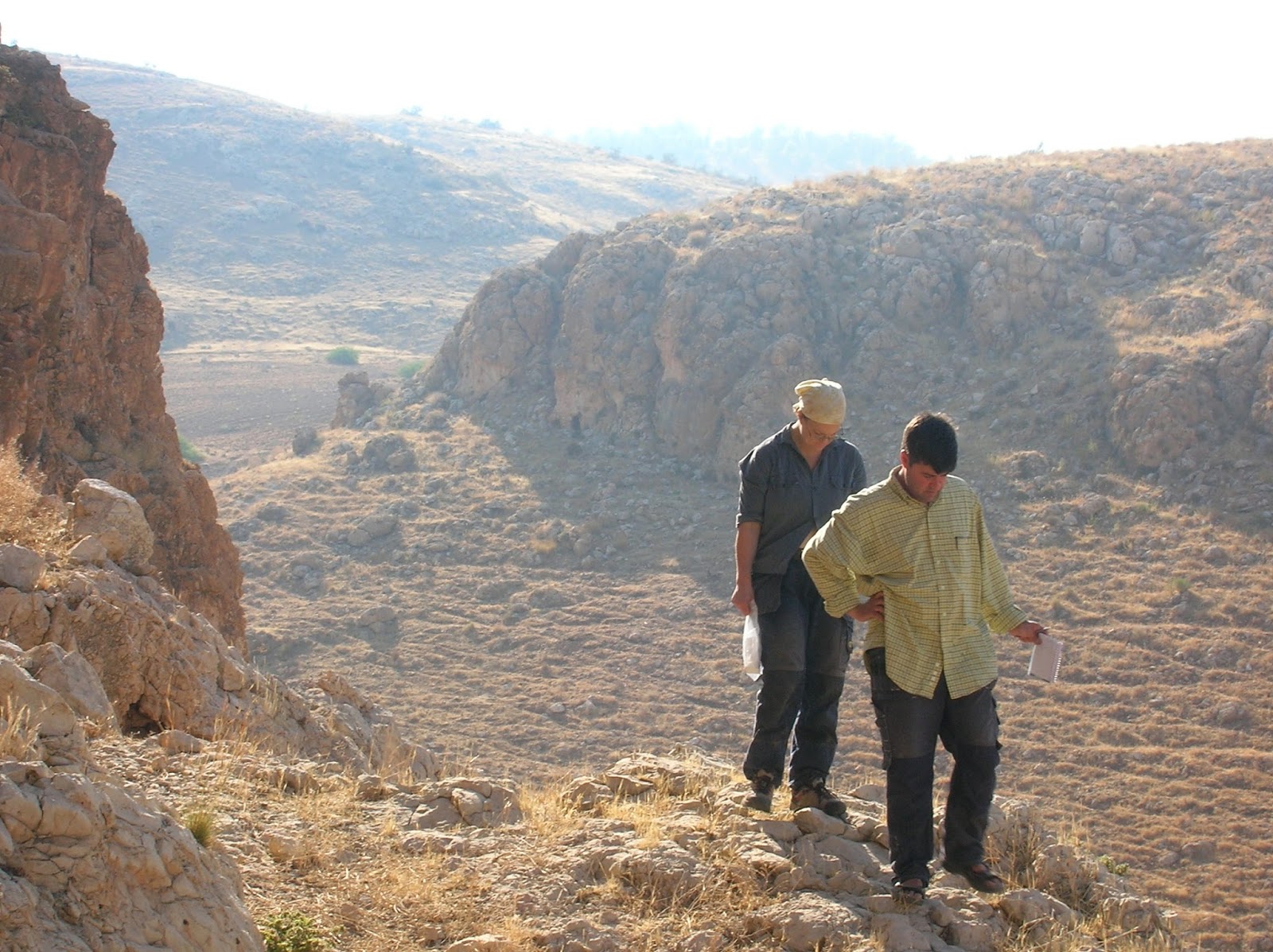
Liv Nilsson Stutz and Aaron Stutz in the field, on the terrace of Mughr el-Hamamah.

This pivotal time also marked the ebbing of Neanderthals as a last wave of anatomically modern humans spread out from Africa and into the Near East. This region, also known as the Levant, comprises the eastern Mediterranean at the crossroads of western Asia and northeast Africa. As the final surge of modern humans passed through the Levant, they would likely have encountered human populations that arrived earlier, and they may also have interbred with Neanderthals.

“Our find sits right in the Levantine corridor, midway between the Dead Sea and the Sea of Galilee, where each generation expanding into Eurasia would have foraged for food and made campsites,” Stutz says. “We don’t know if these toolmakers were mainly Neanderthals or anatomically modern humans, but recent evidence from other studies now raises the possibility that they were a mix of different populations. What we see at the Mughr el-Hamamah site is that individuals were starting to live, work and form families in larger, more culturally structured social networks.”

Mughr el-Hamamah is located in a limestone outcrop 240 feet above sea level. It overlooks the Jordan Valley, opposite the Nablus Mountains in the West Bank. The Stutzes, a husband-and-wife team, led excavations of the cave in 2010, funded by a grant from the National Science Foundation.

The relatively undisturbed Upper Paleolithic layer included fireplaces stacked atop one another that yielded chunks of well-preserved charcoal from hearths associated with the tools. Co-authors Jeff Pigati of the U.S. Geological Survey and Jim Wilson of Aeon Laboratories derived radiocarbon dates for the charcoal specimens, using advanced techniques that minimized the chances of contamination.

Listen to Liv Nilsson Stutz, senior lecturer in Emory anthropology, describe the artifacts, in the slideshow below:


The cave is about 30-feet deep with an entrance about 20-feet wide. “We can speculate that several families shared the space and worked alongside one another,” Aaron Stutz says. “We found burned animal bones, so they were likely roasting meat, and perhaps boiling plants in hides suspended over their fires as they sat nearby making tools. From the mouth of the cave, they would have had a commanding view of what was likely wetlands and open-vegetation terrain. They could see approaching visitors and deer and gazelle wandering in the distance. If their kids were playing outside, they might also be watching for leopards or other predators.”

Toolmaking was a major activity of the group, as evidenced by their prolific output. Co-author John Shea, an anthropologist from Stony Brook University and an expert flint knapper himself, is continuing to analyze the thousands of implements they left behind.

Many discoveries of Near Eastern tool assemblages dating prior to the early Upper Paleolithic show that humans focused on just one technology. The tools tend to look similar and likely served many uses – the Stone Age version of a Swiss Army Knife. “It takes a good bit of cleverness to be able to devise a tool that helps you cover lots of different situations,” Stutz says. “And it makes sense in a context where you don’t necessarily know what you’re going to need your piece of flint for that day.”

The group of toolmakers at Mughr el-Hamamah, however, used different technologies to get different tools. “They were investing in the kinds of activities that require maintaining relationships and group planning,” Stutz says. “They were gearing up for a clearly defined division of labor, including firewood gathering, plant gathering, hunting and food foraging.”

They produced large quantities of blades for knives, and for hafting onto spears, using a prismatic blade technique that yields long, narrow points that are nearly identical. “This standardization minimizes waste of the rock while maximizing the end product,” Stutz says. “It’s the conceptual forerunner to assembly-line production.”

Through this method, the toolmakers could have efficiently produced the armature for multiple hunters going out on a lengthy foray, increasing the chances for finding and striking a target, he says.

“It would have been socially advantageous for individuals to give blades that they made to others, to entice them to stay together as a group,” he adds. “That kind of reciprocity builds relationships. And the stronger the connectivity of your social networks, the greater chance of increasing the number of calories and the quality of nutrients for the group.”

One of the tools made with the Levallois technique, used by Neanderthals and anatomically modern humans alike in earlier periods.

Artifacts from the cave also included scraping tools, made on thick blades for hafting onto a handle and likely used for working wood and animal hides. Other tools continued to be crafted with what is known as the Levallois technique, which was more often used to make the multi-use flakes and triangular points so common in earlier periods.

Even more surprising, Shea’s analysis identified hundreds of basic flakes made from the oldest, easiest Stone Age technology of striking a rock that the toolmaker balances on a stone anvil. These tiny, sharp flakes may have served almost like disposable cutlery – handy implements that could be grabbed for a variety of purposes and tossed aside when no longer needed, Stutz says.

It is not yet known if the few fragments of human bones found at Mughr el-Hamamah have left enough intact fragments of DNA for any genetic analysis. But the diverse tool technologies, in use throughout the occupation period of the cave, support the theory of hunter-gatherer populations starting to band together in larger, more interconnected social networks.

As humans began to dominate the landscape, the researchers theorize, they reached a population density threshold for living in larger groups and gained access to a range of technologies. That process may have helped tip the balance for the rise of modern human culture and the disappearance of the Neanderthals.

“Our findings positively show that the cultural changes associated with Neanderthal extinction in the Near East and wider western Eurasia really are more complex than many leading researchers have assumed,” Stutz says. “Instead of looking for a smoking-gun technology or climatic fluctuation or volcanic eruption, it’s clear we need to look at interconnected behavioral, population and ecological processes. That approach might reveal more clearly the similarities, as well as differences, between our mainly African, and slightly Neanderthal, biological inheritance.”

Additional co-authors of the study are: Jason Rech of the University of Miami; Miriam Belmaker of the University of Tulsa; Rosa Maria Alert and Dan Cabanes of the University of Barcelona; Trina Arpin, an independent researcher in Boston; Jaime Clark of the University of Alaska, Fairbanks; Gideon Hartman of the University of Connecticut; Fuad Hourani of the University of Jordan and Chantel White of the University of Notre Dame.

Credits: Tool photos by Aaron Stutz; field photo by Julie Margolis.

Related:
Complex cognition shaped the Stone Age hand axe
Modern population boom traced to pre-industrial roots

Thursday, June 11, 2015

How a paleontologist got his career on track


Ichnology is a subdiscipline of paleontology that focuses on tracks and traces. "This way of seeing prehistoric life has no greater champion than Emory University paleontologist Anthony Martin," writes Brian Switek on the National Geographic site Phenomena. "Martin has pondered over the meaning of dinosaur burrows, cataloged how traces of modern life can help us interpret the past, and eloquently expressed why no picture of the past is complete without considering what trace fossils tell us."

Watch the above video to learn more about Martin's philosophy on developing "ichnovision."

Related:
Bringing to life 'Dinosaurs Without Bones'
Polar dinosaur tracks open new trail to past

Monday, June 8, 2015

Walt Disney's little-known 'Skeleton Dance'

A still from "The Skeleton Dance." Watch the full short in the YouTube video below.

Sean Braswell of OZY writes in USA Today about a disturbing encounter that the young Walt Disney had with an owl, and how it may have marked his later life and work. Following is an excerpt from the article:

"There is a persistent, and unsubstantiated, rumor that Walt Disney's cryogenically frozen body resides in a vault, waiting to be restored to life when summer returns to Arendelle and modern science triumps over death. It's easy to see how the rumor may have been started since, from the beginning of Disney's career, as chronicled by professor Gary Laderman of Emory University, the American icon had a curious obsesson with death. As early as 1929, on the heels of his first big splash with Mickey Mouse as Steamboat Willie, Disney offered a biazrre follow-up entitled The Skeleton Dance, which opens, not surprisingly, with a terrified owl perched in a tree. ...

"The graveyard romp turned out to be a macabre hit, and over the next decades, as America faced economic hardship, war, nuclear annihilation and drastic social change, Disney's films helped the nation navigate good and evil, vice and virtue. And for most of his early tales, Laderman observes, 'death, or the threat of death, is the motor, the driving force that enlivens each narrative.'"

Read the whole article in USA Today.


Tuesday, June 2, 2015

Biologist Berry Brosi on Obama's 'plan bee'

"The fate of bees will affect people very viscerally," says Berry Brosi, shown tending his hive on the roof of Emory's Math and Science Center.

By Carol Clark

President Obama recently launched perhaps the most ambitious national plan ever aimed at protecting insects. The National Strategy to Promote the Health of Honeybees and Other Pollinators calls for an “all hands on deck” approach to slow their alarming declines. “Pollinators are critical to our nation’s economy, food security and environmental health,” notes the plan, prepared by the White House Pollinator Health Task Force.

“It’s an important wake-up call,” says Berry Brosi, an Emory biologist and ecologist whose research encompasses both managed honeybees and wild bees. “It’s past time for us to realize the vital links between biodiversity, our environment and our own well-being. Ultimately, that’s what this national plan is about.”

Honeybee pollination alone is worth more than $15 billion to U.S. agriculture, “providing the backbone to ensuring our diets are plentiful with fruits, nuts and vegetables,” the plan states. “Pollinators, most often honeybees, are responsible for one in every three bites of food we take.”

“This isn’t about saving an exotic animal in a faraway place, like the panda,” Brosi says. “We’re talking about the possibility of not having nuts and fruits for our breakfast, shortages of tomatoes and melons, and rising milk prices due to a lack of alfalfa pollination.”

Bees are important to more than just food crops, he adds. Cotton plants, for example, need pollination to produce the fibers that are a cornerstone of the garment industry.

“The fate of bees will affect people very viscerally,” Brosi says.

Pollinators are responsible for one out of every three bites of food we eat.

Many pollinators, including bees, birds, butterflies, bats and other animals, are in serious decline in the United States and worldwide. Brosi is one of 75 authors working on a global assessment of pollinators for the UN’s Intergovernmental Panel for Biodiversity Ecosystem Services (IPBES).

“In some places in China, people are hand-pollinating apple trees because they don’t have enough of an insect workforce to do it,” Brosi says. “Examples like that should be sobering. Pollination is an extremely labor-intensive task that bees are specially evolved to do.”

Currently, about 2,000 commercial U.S. beekeepers manage their bee colonies as “livestock,” traveling across the country to service pollination contracts with farmers and honey producers. Each year, however, the number of bee colonies has gone down even as beekeepers struggle to rebuild them. Since the 1940s, when there were about 5.7 million colonies in the United States, the number of managed colonies has shrunk by nearly half, according to the USDA.

“Wild bee populations are also declining wherever we look, although we don’t have good long-term data,” Brosi says. “Several species of bumble bees, for example, are declining at alarming rates, and we’ve seen the extinction of at least one species in the United States during the last 20 years.”

The reasons for these losses appear to be myriad and complex, ranging from shrinking habitats to parasites, diseases and pesticide use.

Monarchs need milkweed to survive.
The phenomenon of the winter migration of the monarch butterfly, from across the United States to Mexico, is also imperiled. The three lowest overwintering populations of the Eastern monarch on record have occurred during the last 10 years. The all-time low was recorded last winter, when the monarchs occupied just 0.67 hectares, or 10 percent of the habitat in Mexico that they did two decades ago.

Emory evolutionary biologist Jaap de Roode, who runs one of the few labs in the world focused on monarch butterflies, says that most of this decline is due to disappearing habitat, especially the milkweed plants that monarchs feed on as caterpillars. “Preservation of remaining milkweed and restoration of habitat are key to maintaining the spectacular migration of this iconic insect,” de Roode says.

The White House pollinator strategy outlines specific aims and a timeline to achieve them, including:

Reduce honeybee colony losses during the winter to no more than 15 percent within a decade. 

Boost the overwintering population of the Eastern monarchs by 225 million butterflies occupying approximately six hectares (15 acres) of habitat in Mexico by 2020. 

Restore or enhance seven million acres of land for pollinators over the next five years. 

The strategy recommends an additional $20 million in funding for the USDA specifically for pollinator research and an additional $1.5 million for the Environmental Protection Agency’s pesticide research programs.

“It’s great that the strategy has specific goals and recommendations, but it doesn’t go nearly far enough, particularly in the area of pesticides,” Brosi says.

Ninety percent of flowering plants and many other animals, not just humans, depend on pollinators for their survival.

A class of pesticides known as neonicotinoids, for example, are widely used in the United States but banned in Europe due to their effect on bees. While neonicotinoids may not kill bees outright, they can have devastating sub-lethal effects, Brosi says. Even minute doses of these pesticides have been found to hamper bees’ learning, memory and navigation skills.

The national pollinator plan calls for an expedited review of the use of neonicotinoids in the United States, to be completed by 2018. “That’s not soon enough,” Brosi says, adding that the plan’s recommendation for $1.5 million for the EPA’s pesticide programs is a drop in the bucket.

“We need to do serious assessments of the effects on pollinators for a wide range of pesticide types,” Brosi says. “We don’t know much about alternatives to neonicotinoids. Farmers could replace them with something even worse.”

Ninety percent of flowering plants and many other animals, not just humans, depend on pollinators for their survival. “There could be a lot of hidden declines occurring in association with declines in pollinators that we won’t pick up on for a long time,” Brosi says. “A lot of trees are long-lived, for example, so if their populations are not regenerating normally we may not notice it right away. That’s frightening, and one of the areas I’m most concerned about.”

One optimistic note is that bees and other insect pollinators tend to be highly resilient, Brosi adds. “They can thrive in places you wouldn’t expect, such as cities. It’s an interesting conundrum that pollinators do the worst in industrial agriculture areas where we need them the most. A bigger solution to this problem needs to be re-imagining the ways in which our agricultural system functions. When you limit the diversity of plant species and douse fields with pesticides, it can have a lot of unintended negative consequences.”

Related:
Bees 'betray' their flowers when pollinator species decline 
Emory to ban bee-harming pesticides
Mystery of monarch migration takes new turn
Pumping wings: Muscles make migrating monarchs unique
Democracy works for Endangered Species Act